

How RCTs and Small Bowel Sampling Change the Sweetener Gut Microbiome Story
Artificial sweeteners can shift the composition of your gut microbiome, but the effect is inconsistent and depends heavily on which sweetener, how much, and who is eating it. Saccharin and sucralose carry the strongest evidence for altering microbial populations, while animal studies show clearer disruption than human trials do. The honest answer is a qualified yes with real caveats; it’s not a clean verdict either way. The sections below break down the mechanisms, the sweetener-specific data, and what to actually watch if you’re concerned.
TL;DR:
- Human randomized trials, like the 10-week sucralose study, suggest non-caloric sweeteners can influence insulin responses without affecting blood sugar levels.
- Animal studies show saccharin and sucralose often reduce beneficial gut bacteria and produce metabolic changes, though these effects don’t always translate to humans.
- Sweeteners interact with gut microbes mainly by passing through the gut and being metabolized as foreign chemicals, which can shift bacterial populations and their byproducts like short-chain fatty acids.
- Different sweeteners have varying levels of evidence: sucralose and saccharin show the strongest links to microbiome and metabolic effects, while stevia and polyols may have milder or beneficial influences.
- Study inconsistencies often stem from differences in doses, sampling sites, duration, and how sweeteners are consumed within overall diets, making firm conclusions challenging.
Table of Contents
- What the Research on Artificial Sweeteners and Gut Bacteria Actually Shows
- How Sweeteners Actually Interact With Your Gut Bacteria
- Sweetener by Sweetener: Which Ones Have the Strongest Evidence Against Them
- Why the Studies Keep Disagreeing With Each Other
- What This Means for Your Blood Sugar and Metabolic Risk
- Practical Steps for Protecting Your Gut While Using Sweeteners
- The Research and Assets Behind This Guidance
- What the Research Still Needs to Settle This Debate
- A Prebiotic-First Option Worth Considering Alongside Dietary Changes
- FAQ
What the Research on Artificial Sweeteners and Gut Bacteria Actually Shows
Three types of evidence feed into this conversation, and they don’t always agree with each other. Human randomized trials give you the most trustworthy signal but the smallest sample sizes. Observational studies cover more people but drown in confounding variables. Animal models show the loudest effects but don’t always translate to human physiology. Understanding which bucket a finding comes from is the difference between reading the science accurately and getting whiplash from headlines.
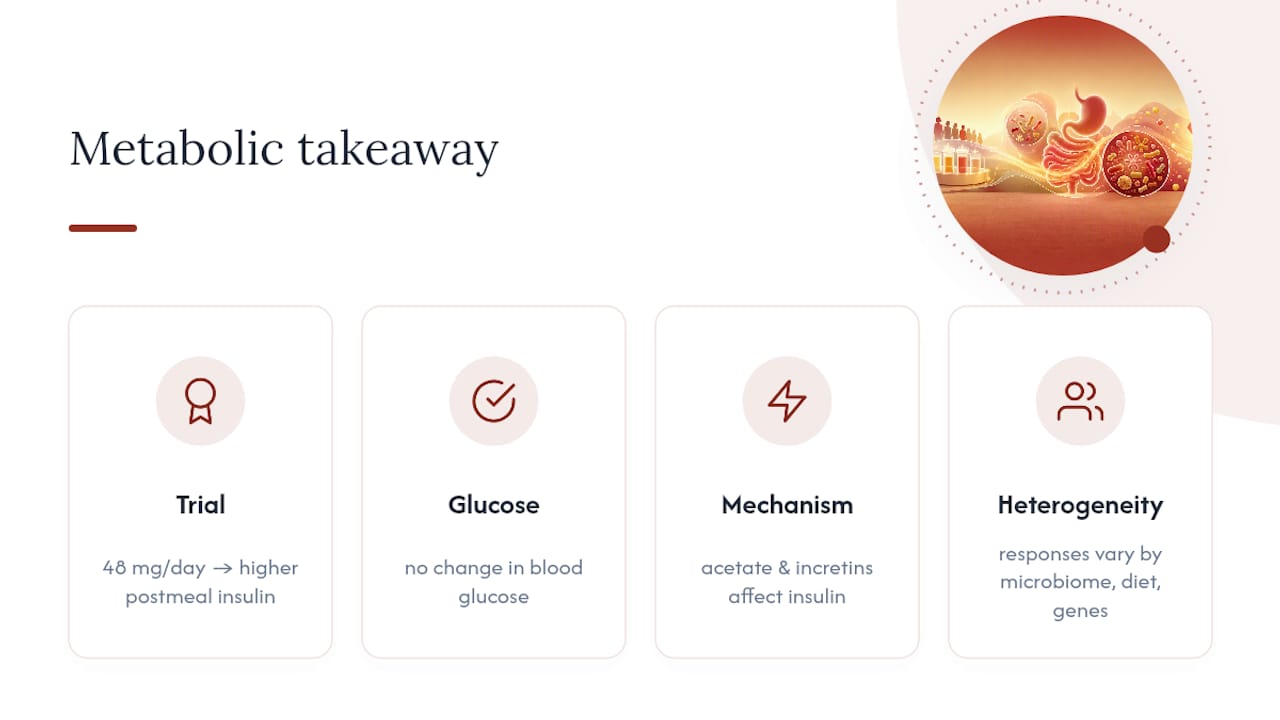
The clearest human data point comes from a randomized, double-blind trial in healthy young adults who consumed 48 milligrams of sucralose daily for 10 weeks. Researchers recorded increased serum insulin concentrations at multiple points after meals, a signal that something metabolic was happening even without a corresponding rise in blood sugar. That’s the kind of finding that makes a nutrition scientist sit up: a non-caloric compound producing an insulin response usually reserved for actual sugar.
Observational research tells a messier story. Cohort and cross-sectional studies linking sweetener consumption to microbiome composition or metabolic markers struggle with a basic problem: people who drink diet soda tend to differ from people who don’t in dozens of other ways, from baseline body weight to overall diet quality to activity levels. A 2025 review covering artificial sweeteners and the gut microbiome concluded that findings across human and animal research remain inconsistent, with animal studies more reliably showing drops in beneficial bacteria and shifts in short-chain fatty acid production, while human studies produce milder, more variable results.
Animal models are where the dysbiosis story gets loud. Mice given saccharin or sucralose in controlled feeding experiments frequently show reduced microbial diversity, lower counts of beneficial genera, and metabolic changes that look like early glucose intolerance. The catch: mice have different baseline microbiomes, different diets, and different doses relative to body weight than humans do. A finding that holds up cleanly in a C57BL/6 mouse fed sweetener in its drinking water doesn’t automatically hold up in a person eating a granola bar with sucralose once a day.
Here’s a rundown of the studies that carry the most weight in this field:
- The sucralose randomized trial showing elevated postprandial insulin after 10 weeks of daily exposure.
- The 2025 comprehensive review framing sweetener effects on the microbiome as inconsistent but biologically plausible.
- A systematic review identifying saccharin, sucralose, and to a lesser degree stevia as the sweeteners with the most consistent evidence of altering gut microbial composition.
- A metabolic syndrome-focused review documenting how non-nutritive sweeteners interact with the microbiome and why individual responses vary so widely.
- Cedars-Sinai’s small-bowel sampling research, which found sweeteners can meaningfully alter the small intestine’s microbial environment in ways stool testing alone would miss.
Taken together, these studies don’t prove artificial sweeteners are dangerous. They prove the question is more complicated than “sweetener bad” or “sweetener fine,” and that complexity is exactly why blanket claims in either direction deserve skepticism.
How Sweeteners Actually Interact With Your Gut Bacteria
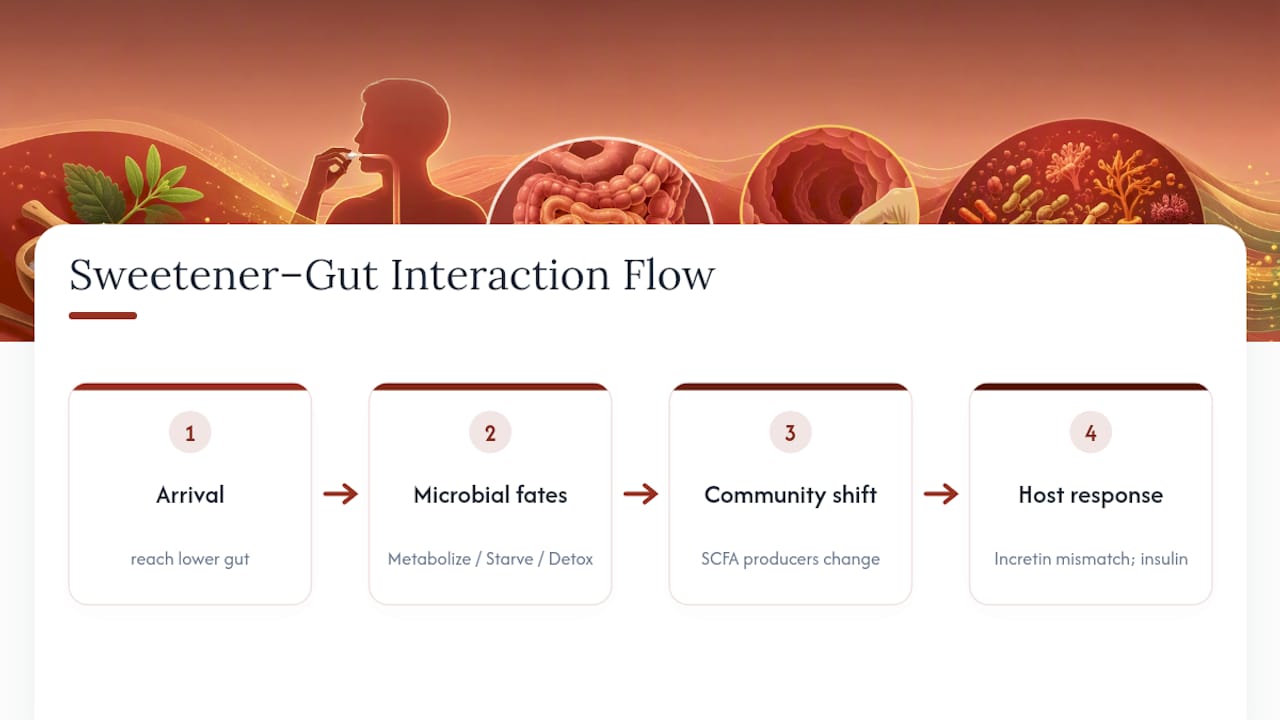
Think of your gut microbiome as a densely populated city, and artificial sweeteners as a new building material nobody planned for. Some microbes can metabolize it. Some can’t touch it and starve out. Some treat it like a foreign substance and mount a defense. That’s roughly what happens at the molecular level when non-nutritive sweeteners pass through your digestive tract.
Most artificial sweeteners aren’t absorbed the way sugar is. They travel further down the gut before microbes get a chance to process them, and many bacteria treat these compounds the way they’d treat any unfamiliar chemical, running xenobiotic metabolism pathways typically reserved for detoxifying foreign substances. That processing isn’t neutral. It can shift which bacterial species thrive and which get outcompeted, and it can change the metabolic byproducts those bacteria produce.
One of the most consequential downstream effects involves short-chain fatty acids, or SCFAs, the fermentation byproducts your gut bacteria produce from fiber and other substrates. Butyrate, acetate, and propionate aren’t just microbial waste. They fuel colon cells, regulate inflammation, and send signals to your liver, muscle, and pancreas about energy status. When sweetener exposure shifts the bacterial populations responsible for producing these compounds, the downstream signaling changes too, and that’s not a trivial detail if you’re trying to understand where the insulin changes in the sucralose trial might be coming from.
Incretin hormones add another layer. These are the signals your gut releases after eating that tell your pancreas how much insulin to release and tell your brain you’re full. Sugar reliably triggers this cascade. Artificial sweeteners often don’t, at least not to the same degree, and researchers studying this gap in incretin signaling think it may partly explain why some non-caloric sweeteners still produce measurable insulin responses. The sweetness signal reaches your brain, but the hormonal handshake that normally accompanies caloric intake doesn’t happen the same way, and that mismatch may confuse metabolic regulation over time.
There’s also a more direct, almost pharmacological effect. Laboratory research has found that sweeteners like acesulfame K and saccharin can act as bacteriostatic agents at concentrations relevant to real consumption, meaning they slow or halt bacterial growth outright rather than simply altering the competitive balance. Studies out of Cambridge found that certain sweeteners slow the growth of beneficial species like Roseburia intestinalis, and combining sweeteners with certain common medications amplified that inhibition in lab assays. Separate work published in Trends in Microbiology found similar sweeteners can interfere with bacterial conjugation and reduce biofilm formation, the kind of structural effect that matters because biofilms are how many gut bacteria organize themselves into stable, cooperative communities. Disrupt the biofilm, and you disrupt the neighborhood.
None of these mechanisms operate in isolation. A sweetener that suppresses one bacterial species might indirectly boost another that competes for the same resources, and the net effect on your SCFA output, your incretin signaling, and your inflammatory tone depends on which microbes you started with in the first place.
Sweetener by Sweetener: Which Ones Have the Strongest Evidence Against Them
Lumping every artificial sweetener into one category is where a lot of consumer confusion starts. Sucralose and stevia are chemically unrelated compounds with different metabolic fates, and treating them as interchangeable “fake sugar” obscures real differences in the evidence.
Sucralose has the most direct human trial data tying it to a measurable metabolic change. The randomized trial using 48 milligrams daily for 10 weeks found elevated postprandial insulin levels in healthy adults, a finding that’s hard to dismiss given the study’s controlled design. Animal research adds a second concerning thread: some mouse models show sucralose exposure increases susceptibility to colitis-like inflammation, suggesting a possible gut barrier effect on top of the metabolic one. Human data on colitis susceptibility specifically is much thinner, so that connection stays in the “plausible, not proven” category for people.
Saccharin shows some of the clearest mechanistic evidence in animal models. Mouse studies have repeatedly demonstrated that saccharin-driven glucose intolerance is mediated by the gut microbiome itself. Transferring the microbiome from saccharin-exposed mice into germ-free mice transfers the glucose intolerance along with it, which is about as strong a causal signal as microbiome science gets. Human responses to saccharin are far more mixed, with some people showing similar glucose changes and others showing none at all, likely reflecting how much your baseline microbiome composition determines your individual response.
Aspartame and acesulfame K occupy a murkier middle ground. Evidence for meaningful human microbiome disruption from either compound is inconsistent across studies, but lab research shows both can exert bacteriostatic effects on certain species at concentrations you’d realistically encounter in heavily sweetened products. Acesulfame K in particular has drawn attention for its stability. It passes through digestion largely unmetabolized, which means whatever contact it has with your gut bacteria happens at a fairly consistent concentration from mouth to colon.
Stevia sits in an interesting spot. It’s plant-derived rather than synthetic, but from a microbiome standpoint, it behaves more like a non-nutritive sweetener than a prebiotic. A systematic review on non-nutritive sweeteners and gut microbiota found stevia shows some evidence of altering microbial composition, though less consistently than saccharin or sucralose.
Polyols, including erythritol, xylitol, and sorbitol, work through a genuinely different mechanism. Rather than resisting fermentation, many polyols actually feed beneficial bacteria, producing prebiotic-like effects in some studies. The tradeoff is gastrointestinal tolerance. Polyols are poorly absorbed in the small intestine, and at higher doses they pull water into the gut and ferment aggressively, which is exactly why sugar-free gum and candy come with the familiar digestive warning labels. If your goal is gut-friendly sweetness, polyols in moderate amounts may be the more defensible category, but “moderate” is doing a lot of work in that sentence.
A few takeaways worth holding onto from this sweetener-by-sweetener comparison:
- Sucralose and saccharin carry the strongest combined human and animal evidence for microbiome and metabolic effects.
- Aspartame and acesulfame K show bacteriostatic potential in lab conditions but weaker consistency in whole-body human outcomes.
- Stevia shows moderate evidence of microbial alteration, less pronounced than saccharin or sucralose.
- Polyols can support beneficial bacteria but cause dose-dependent GI symptoms at higher intakes.
Why the Studies Keep Disagreeing With Each Other
If you’ve read conflicting headlines about sweeteners and gut health, the disagreement usually traces back to methodology, not to sloppy science. Four variables in particular explain most of the contradictions you’ll find across this research.
Dose is the first. The sucralose trial that found elevated insulin used 48 milligrams daily for 10 weeks, a level chosen to sit within a realistic consumption range but still well below the FDA’s acceptable daily intake. Many industry-funded studies use single, lower doses over shorter windows and unsurprisingly find smaller effects. Comparing a 10-week chronic exposure trial to a single-dose acute study and expecting matching conclusions is a methodological mismatch, not evidence that one study is wrong.
Sampling site is the second, and it’s underappreciated outside specialist circles. Most microbiome research analyzes stool samples because they’re easy to collect, but stool reflects the colon, the very end of a long digestive road. Sweeteners interact with bacteria throughout the gut, including the small intestine, and research directly comparing sample sites has found that small-bowel shifts don’t always show up in stool at all. Cedars-Sinai’s investigation into the small bowel specifically found that sweeteners produced significant alterations in that region’s microbial makeup, changes a stool-only study design would have missed entirely. Given that the small intestine is where a lot of nutrient absorption and early metabolic signaling happens, this sampling gap may explain why some studies find nothing while others find a lot.
Duration and formulation round out the picture. A two-week study and a ten-week study aren’t measuring the same phenomenon, since microbial communities can adapt, rebound, or continue shifting over time in ways a short trial can’t capture. And testing a pure sweetener compound in isolation is different from testing the sweetener as it appears in a commercial soda or protein bar, loaded with other additives, acids, and preservatives that have their own independent effects on gut bacteria. Confounding diet is the quiet variable running underneath all of it. Someone who drinks four diet sodas a day rarely has an otherwise pristine diet, and separating the sweetener’s effect from everything else on their plate is one of the hardest problems in nutrition research.
What This Means for Your Blood Sugar and Metabolic Risk
The metabolic question people actually care about is simple: does this affect my blood sugar control? The honest answer is that it might, for some people, under some conditions, and the mechanism is plausible enough to take seriously without panicking.
The sucralose trial’s insulin findings are the centerpiece here. Healthy young adults consuming 48 milligrams daily for 10 weeks showed elevated insulin at several points after meals, without a corresponding change in blood glucose readings. That pattern, rising insulin without rising glucose, suggests something is prompting extra insulin release or slightly reducing insulin sensitivity, even though the sweetener itself carries zero calories and no direct glycemic load. It’s the kind of disconnect that makes a straightforward “calories in, calories out” model of sweeteners look incomplete.
The mechanistic bridge between microbiome changes and this insulin pattern likely runs through the SCFA and incretin pathways discussed earlier. Acetate, one of the primary SCFAs produced by gut fermentation, interacts with pancreatic beta cells and can influence insulin secretion patterns. If sweetener exposure shifts which bacteria dominate your gut and how much acetate they produce, that’s a plausible pathway connecting a non-caloric compound to a real hormonal response. The insulin sensitivity connection between microbial metabolites and pancreatic signaling is one of the more active research areas in metabolic microbiome science right now.
But heterogeneity matters enormously here, and it’s the reason nobody should read this section as a universal warning. Individual responses depend on your starting microbiome composition, your overall diet, medication use, and even genetics. A 2025 review covering this exact variability points out that some people show clear microbiome-driven glucose changes in response to non-nutritive sweeteners while others show virtually none, and current science can’t yet reliably predict which category a given person falls into before testing them directly.
If you already manage insulin resistance, prediabetes, or type 2 diabetes, that individual variability is exactly why generic reassurance (“sweeteners are fine, they have no calories”) and generic alarm (“sweeteners are toxic to your gut”) are both oversimplified. Your actual risk profile depends on your existing metabolic baseline, not on a population average.
Practical Steps for Protecting Your Gut While Using Sweeteners
You don’t need to eliminate every non-nutritive sweetener from your life to take this research seriously. You do need a plan more thoughtful than “avoid everything” or “ignore it entirely.” Here’s a stepwise approach that respects both the uncertainty in the science and the reality that most people aren’t going to run a controlled trial on themselves.
- Audit your actual intake first. Most people underestimate how many sweetened products they consume daily, from flavored waters to protein bars to “sugar-free” condiments. Write down every source for a few days before changing anything.
- Run a short elimination and rechallenge. Cut artificial sweeteners for two to three weeks, note any digestive or energy changes, then reintroduce your primary sweetener and watch for differences. This gives you personal data instead of relying on population averages that may not apply to you.
- Prioritize fiber and whole-food sweetness. Fruit, dates, and naturally sweet vegetables deliver sweetness alongside fiber that feeds beneficial bacteria, rather than compounds that may suppress them. Building a foundation of beneficial bacterial diversity through fiber gives your microbiome more resilience against any single dietary stressor.
- Approach polyols with portion awareness. If you tolerate erythritol or xylitol well, they may be a gentler option, but respect the dose-dependent GI effects and don’t assume “natural-sounding” means unlimited.
- Track objective markers if you’re at elevated risk. Fasting glucose, HbA1c, and basic metabolic panels give you real data points rather than guesswork.
If you’re pregnant, managing inflammatory bowel disease, or dealing with metabolic syndrome, loop in your clinician before making major swaps in either direction. These are populations where gut sensitivity and metabolic stakes are both higher, and the general population research doesn’t always generalize cleanly to them.
Pro Tip: Run your personal test for four to eight weeks, not four to eight days. Track three things weekly: digestive symptoms (bloating, urgency, regularity), a fasting glucose reading if you have access to a home glucometer, and simple energy or hunger patterns. Short trials catch acute reactions; they miss the slower shifts in insulin sensitivity that studies like the sucralose trial only detected after 10 weeks of consistent exposure.
The Research and Assets Behind This Guidance
This article draws on peer-reviewed systematic reviews, randomized controlled trial data, and small-bowel sampling research rather than marketing claims or single-study extrapolations, and every specific figure cited traces back to a named study. The formulation work centers on prebiotic fiber, superoxide dismutase, polyphenols, and Lactobacillus, which is part of why microbiome research gets this level of scrutiny on our blog in the first place.
None of this replaces medical care. If you’re managing diabetes, IBD, or another condition where gut and metabolic health carry real stakes, a supplement is an adjunct to your plan, not a substitute for your clinician’s guidance. For more background on the mechanisms discussed here, our pieces on gut bacteria and blood sugar and prebiotic fiber’s role in metabolic health go deeper into the underlying biology.
What the Research Still Needs to Settle This Debate
The biggest gap in this field isn’t a lack of studies. It’s a lack of standardization. Researchers use wildly different doses, timelines, and sweetener formulations, which makes cross-study comparison nearly impossible. I’d like to see more trials adopt the small-bowel sampling approach Cedars-Sinai used, paired with cohorts followed for a year or longer rather than a few weeks.
Until that evidence matures, my stance is cautious moderation, not elimination. Non-nutritive sweeteners still offer real calorie and blood sugar advantages over added sugar for many people, and the microbiome effects documented so far are real but not catastrophic for most healthy adults. If you have metabolic syndrome, IBD, or another condition where gut health carries higher stakes, bring your clinician into the decision before you swap sugar for sweetener at scale.
— Larry
A Prebiotic-First Option Worth Considering Alongside Dietary Changes
If you’re rethinking your sweetener intake, the other side of the equation is what you’re feeding the bacteria you already have. A daily gel combines prebiotic fiber with superoxide dismutase, polyphenols, and Lactobacillus, a formulation built around supporting microbial resilience rather than eliminating any single dietary compound.
Prebiotic fiber works by giving beneficial bacteria the fermentable substrate they need to produce SCFAs like butyrate and acetate, the same metabolites disrupted when sweetener-driven dysbiosis suppresses certain bacterial populations. Pairing dietary adjustments, like the elimination and rechallenge approach outlined above, with a daily source of prebiotic fiber gives your microbiome more raw material to rebuild with while you sort out which sweeteners your body tolerates well. It is not claimed to reverse sweetener-related microbiome changes, but a consistent prebiotic input is a reasonable adjunct while running an elimination trial. If you want the specifics on formulation and dosage, the REVIVIFY 30-Day Supply product page lays out exactly what’s in each serving so you can decide if it fits your routine.
FAQ
Which artificial sweetener is easiest on the gut?
Polyols like erythritol tend to be gentler on gut bacteria and may even support beneficial species, though they can cause bloating or digestive upset at higher doses. Among non-polyol sweeteners, the evidence for microbiome disruption is weaker for aspartame and acesulfame K than for saccharin or sucralose.
What is the best sweetener for the gut microbiome?
No sweetener has been shown to actively improve microbiome health the way fiber does, but certain polyols show mild prebiotic effects in some studies. If gut health is your main concern, whole-food sweetness sources paired with a fiber-rich diet remain the more evidence-backed choice over any sweetener category.
What is worse for your body, sugar or artificial sweeteners?
Added sugar has clearer, more established links to weight gain, insulin resistance, and metabolic disease at typical consumption levels. Artificial sweeteners avoid those calorie-driven risks but may introduce microbiome and insulin-signaling effects of their own, so “worse” depends on which specific health outcome you’re weighing.
Does quitting sugar improve gut health?
Reducing added sugar generally supports gut health by lowering the fuel available to less beneficial, sugar-fermenting bacteria and making room for a more fiber-responsive microbial community. It doesn’t automatically mean switching to artificial sweeteners is neutral, since some of those compounds carry their own documented microbiome effects.