

Fiber Timing: Start Small and Keep Meds 1 Hour Before or 2 Hours After
The right moment to take a fiber supplement depends on your goal: before your largest meal to support appetite and blood-sugar control, with meals if your stomach is sensitive, or in the evening if morning regularity is the target. Whichever window you choose, take it with at least 8 ounces of water and keep it separated from prescription medications by about an hour before or two hours after. Consistency matters more than precision, so pick a slot you can repeat daily and increase your dose gradually.
TL;DR:
- Taking fiber before meals with an empty stomach maximizes satiety and blood-sugar control, especially when using soluble fibers like psyllium husk.
- For gut comfort, start with low doses of fermentable fibers and gradually increase while ensuring at least 8 ounces of water per serving.
- Timing fiber around medications requires spacing of at least one hour before or two hours after to avoid interference with absorption.
- Morning dosing benefits blood-sugar regulation and regularity, but consistency over time is more impactful than perfect timing.
- Split doses or starting with lower amounts can reduce bloating, especially when incorporating highly fermentable prebiotics into daily routines.
Table of Contents
- How Fiber Type Determines the Best Time to Take It
- What’s the Best Fiber Timing for Your Specific Goal?
- How Should You Time Fiber Around Medications?
- How Much Water Do You Need and How Fast Should You Increase Your Dose?
- Does It Matter If You Take Fiber at the Same Time Every Day?
- What Role Does Prebiotic Fiber Play in a Daily Routine?
- What Actually Matters More: Timing or Total Intake?
- A Simple Way to Combine Prebiotic Fiber With Daily Cellular Support
- Sources
- FAQ
How Fiber Type Determines the Best Time to Take It
Not all fiber behaves the same way once it hits your gut, and that difference is the real reason “fiber supplement timing” isn’t a one-size-fits-all answer. Soluble fiber dissolves in water and forms a gel-like substance that slows gastric emptying. That slowdown is exactly what makes it useful before meals: it keeps food in your stomach longer, blunts the blood-sugar spike that follows eating, and helps you feel full on less. Insoluble fiber doesn’t dissolve. It adds bulk to stool and speeds up transit through the colon, which makes it more about long-term regularity than immediate satiety.
Fermentation is the other variable. Gut bacteria break down soluble and prebiotic fibers in the large intestine, and that process produces gas as a byproduct. The more fermentable the fiber, the more likely you are to notice bloating, especially in the first few weeks. This is where form matters as much as fiber type.
- Psyllium husk is soluble and moderately fermentable. It works well before or with meals and tends to be gentler than more aggressive prebiotic fibers.
- Inulin and other chicory-root-derived prebiotic fibers ferment quickly and are more likely to cause gas and bloating in sensitive people, a pattern dietitians consistently flag when advising on fiber form and timing.
- Methylcellulose is a synthetic soluble fiber that ferments very little, which makes it a lower-gas option for people who want bulk without the bloat.
- Wheat dextrin and gums fall somewhere in between, generally well tolerated but worth introducing slowly.
The practical takeaway: if your goal is appetite control or blood-sugar management, a soluble fiber like psyllium taken before meals gives you the gastric-slowing effect when you need it most. If your stomach reacts poorly to fermentable fibers, methylcellulose or a lower dose split across two meals will usually cause less trouble. And if you’re using a highly fermentable prebiotic fiber, spreading it across the day rather than dosing it all at once tends to reduce the gas load your gut has to process in one sitting.
What’s the Best Fiber Timing for Your Specific Goal?
Your goal should decide your clock, not the other way around. Here’s how the three most common objectives map to timing.
- Weight management and appetite control: before your largest meal. Soluble fiber taken in this window has time to start absorbing water and thickening in your stomach before food arrives, which means you’re already working with a partially full stomach when you sit down to eat. This pre-meal window is where the satiety benefit of fiber is best documented, and it works best applied consistently to whichever meal tends to trigger overeating, usually dinner.
- Blood-sugar control: before or with breakfast. Morning is a physiologically favorable window for fiber because gut motility and metabolic hormone signaling are more active earlier in the day, according to nutrition experts interviewed by Food & Wine. Taking fiber before your first meal helps flatten the glucose response to whatever carbohydrates follow, and front-loading fiber at breakfast has been linked to better satiety and bowel habits through the rest of the day, a pattern also observed in metabolic outcome research.
- Morning regularity: evening, but not right at bedtime. If your goal is a predictable bowel movement the next morning, taking fiber in the early evening gives it several hours to move through your system overnight. Dosing it immediately before lying down is a different story. Prevention’s nutrition team specifically warns against taking fiber right before bed, since the bulking and gas-producing effects can disrupt sleep and cause nighttime GI discomfort that adjustable bases can help alleviate. Allow a gap of a few hours between your fiber dose and lying down.
- Digestive comfort during the adjustment period: with meals. If your stomach is sensitive or you’re new to fiber supplements, taking your dose alongside food rather than on an empty stomach tends to reduce cramping and lessens the sensation of a fiber gel sitting alone in your stomach.
Each approach carries trade-offs. Pre-meal dosing maximizes satiety but demands more planning since you need a 20 to 30 minute buffer before eating. With-meal dosing is the easiest to remember and gentlest on a sensitive stomach, but it dilutes some of the appetite-suppressing effect because you’re eating at the same time the fiber is still absorbing water. Evening dosing supports regularity beautifully but requires enough of a gap before bed to avoid discomfort.
Pro Tip: If you’re juggling more than one goal, morning-first is usually the best default. Front-loading fiber at breakfast gives you blood-sugar and satiety benefits through the day, and you can still add an evening dose later if regularity remains an issue.
Split dosing is worth considering if a single serving of your fiber supplement causes noticeable bloating. Taking half your target dose in the morning and half in the evening delivers the same total daily fiber with a gentler load on your gut at any one time.
How Should You Time Fiber Around Medications?
Fiber supplements can physically bind to certain drugs in your digestive tract or change how quickly your gut moves them along, which alters how much medication actually gets absorbed. The standard safety rule is to take prescription medications at least one hour before or two hours after your fiber supplement, a spacing guideline echoed across pharmacist and dietitian guidance, including Health on fiber timing and drug interactions.
Some medications need more room than that. Thyroid medications like levothyroxine are particularly sensitive to fiber-related interference and may require a longer separation window, sometimes several hours, depending on the formulation and your prescriber’s guidance. Other drugs affected by this binding effect include certain antibiotics, some cholesterol medications, and specific antidepressants. The mechanism is straightforward once you picture it: fiber forms a gel or bulk matrix in your gut, and if a pill dissolves into that same space, some of the drug can get trapped rather than absorbed into your bloodstream. Changes in transit time compound the problem, because a faster-moving gut gives a medication less time to be absorbed at all.
A short checklist keeps this simple in daily practice:
- Check every prescription label for interaction warnings related to fiber, bulk-forming agents, or bile-acid binders.
- Ask your pharmacist directly about thyroid medications, seizure medications, and any drug with a narrow therapeutic window.
- Build your medication schedule first, then slot your fiber dose into whatever window leaves at least an hour of buffer on each side.
- If you accidentally take them too close together, don’t double up or skip either one. Just resume your normal spacing at the next scheduled dose and mention the slip to your pharmacist if you’re on a sensitive medication.
If you take multiple medications at different times of day, your fiber supplement schedule might end up looking more like a puzzle than a routine. That’s normal, and it’s worth spending five minutes mapping it out once rather than guessing daily.
How Much Water Do You Need and How Fast Should You Increase Your Dose?
Every serving of fiber supplement needs at least 8 ounces of water, no exceptions. Fiber’s whole job is to absorb liquid and expand. Without enough water in the mix, that expansion can happen in your esophagus or intestine instead of safely within a well-hydrated digestive tract, creating a real risk of blockage, a warning dietitians repeat consistently in guidance on fiber supplement safety.
Ramping up slowly matters just as much as hydration. A practical schedule looks like this:
- Start with a low dose—about one third to one half of the manufacturer’s suggested serving—for several days, then gradually increase to the full serving over the next couple of weeks, splitting doses if necessary to reduce bloating.
Track how your body responds as you go. Stool frequency, gas, and bloating are the three signals worth watching, and they’ll tell you whether you’re ready to increase your dose or need to hold steady for another week.
Form affects this ramp too. Powders need to be mixed thoroughly and sipped rather than gulped, since a poorly mixed dose can clump. Psyllium husk in particular thickens quickly, so drink it soon after mixing. Inulin and other prebiotic fibers are more likely to produce gas as your gut bacteria adjust, so starting even lower than the standard recommendation is reasonable if you’re gas-sensitive. Capsules are the easiest to tolerate because they release fiber more slowly, but that same slow release means you’ll wait longer to feel the effect.
Pro Tip: Keep a glass of water next to your fiber supplement, not across the kitchen. The single most common reason people skip the water rule is simple inconvenience, not forgetfulness.
Stop taking your fiber supplement and call a doctor if you experience severe abdominal pain, vomiting, or an inability to pass stool or gas. Those can be signs of a bowel obstruction, and fiber supplements are specifically not recommended if you already have narrowing in your digestive tract, active GI bleeding, or difficulty swallowing.
Does It Matter If You Take Fiber at the Same Time Every Day?
Your gut runs on rhythm. Motility patterns and the microbiome both respond to regular cues, and dietitians consistently point to consistency, not perfect timing, as the variable that actually reduces initial digestive discomfort. A fiber dose taken at roughly the same hour every day gives your digestive system a predictable pattern to adapt to, which matters more over a month than which exact hour you chose in week one.
That said, “roughly the same time” still needs to be the right window for your goal, and figuring that out takes a short experiment rather than a guess. Try this:
- Pick one timing strategy based on your primary goal, whether that’s pre-meal, with-meal, or evening.
- Hold everything else steady for two to four weeks. Don’t change your diet, exercise, or medication schedule at the same time, or you won’t know what caused what.
- Track outcomes weekly. Note stool frequency and consistency, hunger levels between meals, bloating, and blood sugar if you’re monitoring it.
- Adjust based on results, not impatience. If regularity hasn’t improved after four weeks, try shifting your dose earlier in the evening. If appetite control isn’t kicking in, try moving your pre-meal dose closer to 30 minutes rather than 20.
Shift workers and anyone juggling a tight medication schedule may need to build their fiber timing around fixed anchor points, like the start of a shift or a consistent medication window, rather than the clock itself. The principle holds either way: pick a window, protect the medication-spacing rule, and give it real time before deciding it isn’t working.
What Role Does Prebiotic Fiber Play in a Daily Routine?
Prebiotic fiber fits into a daily routine because fiber doesn’t work in isolation. It feeds the bacteria that produce short-chain fatty acids, support gut lining integrity, and influence everything from inflammation to blood-sugar regulation. That systemic connection is part of why some formulas pair prebiotic fiber with other cellular-support ingredients rather than treating fiber as a standalone fix.
If you want to go deeper on how prebiotic fiber interacts with your microbiome day to day, our guide on feeding beneficial gut bacteria daily walks through the mechanics in plain language. For readers managing digestive sensitivity alongside fiber intake, our breakdown of fiber’s role in gut inflammation covers which forms tend to be gentler. And if you’re building out a fuller supplement routine, our piece on choosing prebiotic supplements for gut health lays out the practical differences between common options.
What Actually Matters More: Timing or Total Intake?
Here’s the uncomfortable truth about fiber supplement timing: it’s real, but it’s a secondary lever. The clinical research on dietary fiber is clear that total daily intake and fiber mix drive the bulk of the benefit for regularity, glycemic control, and satiety. Timing optimizes around the edges. If you take the right dose of the right fiber and get the timing wrong, you’ll still see most of the benefit. Get the timing perfect and skip your dose three days a week, and you’ll see almost none of it.
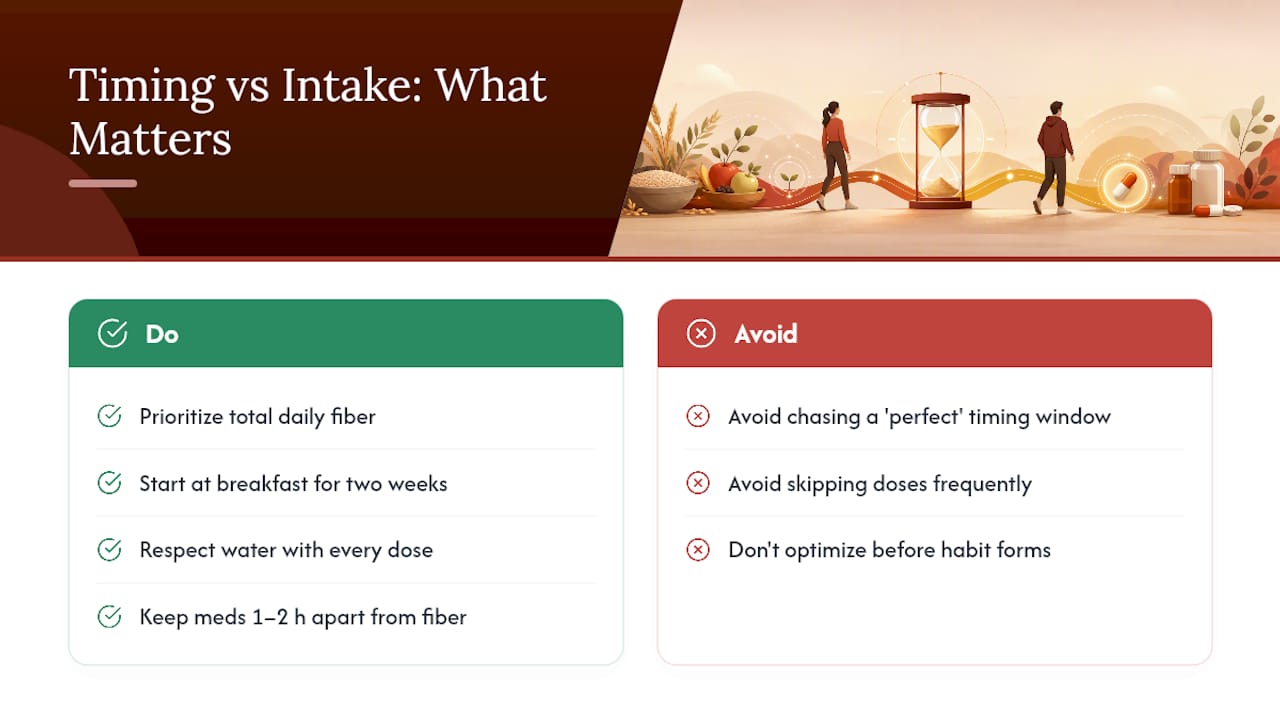
That’s not a reason to ignore timing advice. It’s a reason to stop treating the “perfect” window as the thing standing between you and results. The people who see the best outcomes with fiber supplements aren’t the ones who nailed the 20 minute pre-meal window every single day. They’re the ones who found a slot they could actually stick to for months, respected the water rule without exception, and kept their medication spacing consistent enough that it became automatic. Precision without consistency is a wasted effort. Consistency without precision still works.
My one recommendation if you’re starting today: take your fiber with breakfast for two weeks straight before you touch anything else. Don’t optimize yet. Just build the habit, watch your water intake, and keep your medications on the other side of that one or two hour buffer. Once the habit holds, you can start fine-tuning timing to your specific goal.
— Larry
A Simple Way to Combine Prebiotic Fiber With Daily Cellular Support
If tracking a separate fiber supplement, a separate antioxidant, and a separate probiotic feels like more moving parts than your routine needs, some daily doses combine prebiotic fiber with superoxide dismutase, polyphenols, and lactobacillus, designed to support digestion, blood sugar regulation, and cellular health without asking you to juggle three separate bottles and three separate schedules.

The timing principles in this article still apply. Take it consistently, with enough water, and keep it spaced appropriately from any prescription medications, particularly thyroid medications or anything with a narrow absorption window. If you’re on medication, check with your pharmacist before adding any new fiber source to your day. Tryrevivify is third-party tested and available as a one-time purchase or subscription, and it comes with a risk-free guarantee if it doesn’t fit your routine. If a single-source option sounds like the simplification your morning needs, you can check out Revivify’s daily formula and see how it fits into the timing strategy that works for your goal.
This article is general information, not a substitute for advice from a qualified doctor. Consult a qualified healthcare professional about your own circumstances before acting on anything here.
Sources
- Dietitians Share When to Take Fiber Supplements for Digestion — Prevention
- Want More Fiber in Your Diet? Start With Breakfast, Experts Say — Food & Wine
- Health
FAQ
Does the Timing of Fiber Supplements Really Matter?
Yes, but it’s a secondary factor. Timing can improve satiety, blood-sugar response, or next-day regularity depending on when you take it, but total daily fiber intake and fiber mix drive most of the benefit.
Is It Better to Take Fiber Before Bed or in the Morning?
Morning is generally the stronger choice because gut motility and metabolic activity are more active earlier in the day. Taking fiber right before bed can cause bloating that disrupts sleep, so if you’re using it for morning regularity, dose it in the early evening instead.
How Long Do Fiber Supplements Take to Start Working?
Regularity effects from insoluble fiber usually develop over time, while satiety and blood-sugar benefits from soluble fiber can be noticeable the same day you take it, though full digestive adjustment typically takes two to four weeks.
When Should You Not Take a Fiber Supplement?
Avoid fiber supplements if you have a diagnosed bowel obstruction, difficulty swallowing, or sudden unexplained abdominal pain, and always separate them from medications by at least one to two hours. Stop and call a doctor if you experience severe pain, vomiting, or an inability to pass stool or gas.
Should Fiber Be Taken With Water Only, or Can It Be Mixed With Other Drinks?
Fiber supplements need at least 8 ounces of water or another liquid per serving to move safely through your digestive tract. Juice or a smoothie works too, as long as the total liquid volume meets that minimum.