

How Superoxide Dismutase Protects Vessels and Your Heart
Superoxide dismutase (SOD) is defined as the body’s primary enzymatic defense against superoxide radicals, the most abundant and destructive free radicals produced inside blood vessel walls. Understanding how superoxide dismutase protects vessels means understanding three distinct isoforms: SOD1 in the cytosol, SOD2 in the mitochondria, and SOD3 in the extracellular space surrounding vessel walls. Each isoform guards a different cellular compartment, and together they form a coordinated shield for endothelial oxidative damage. A 2026 clinical study found that people with serum Cu,Zn-SOD levels below 97.2 ng/ml faced 2.71 times higher odds of coronary microvascular dysfunction. That single number makes the stakes clear.
How does superoxide dismutase protect blood vessels?
SOD acts as the first runner in a relay race. It converts the superoxide radical into hydrogen peroxide (H2O2) and oxygen, handing the baton to downstream enzymes that finish the job. Without SOD, superoxide accumulates inside vessel walls, reacts with nitric oxide, and destroys the molecule your blood vessels need most to stay relaxed and open.

The three SOD isoforms each cover a specific cellular territory. SOD1 neutralizes superoxide in the cytosol, where most cellular metabolism occurs. SOD2 handles the mitochondria, the organelle that generates the most superoxide as a byproduct of energy production. SOD3 works in the extracellular space, directly protecting the endothelium from superoxide released into the space between cells.
The table below shows how each isoform contributes to vascular protection.
| Isoform | Location | Primary function |
|---|---|---|
| SOD1 (Cu,Zn-SOD) | Cytosol | Neutralizes cytoplasmic superoxide; most abundant form |
| SOD2 (Mn-SOD) | Mitochondria | Controls mitochondrial superoxide from energy metabolism |
| SOD3 (EC-SOD) | Extracellular space | Protects endothelial surface; regulates vascular tone |
This three-layer coverage matters because superoxide does not stay in one place. A breach in any compartment creates a chain reaction that spreads oxidative damage across the vessel wall.
What molecular mechanisms let SOD preserve vascular function?
The SOD reaction is deceptively simple: superoxide in, hydrogen peroxide and oxygen out. The implications, however, run deep into how your blood vessels regulate blood flow.
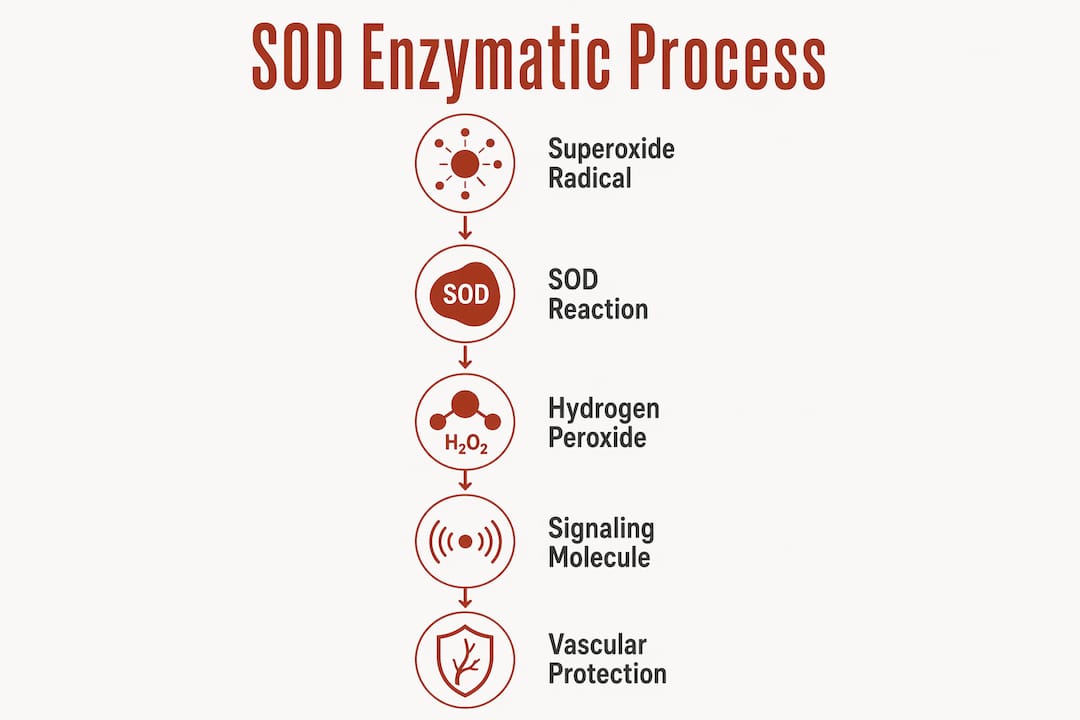
H2O2 is less reactive than superoxide, but it is not inert. At controlled concentrations, H2O2 acts as a signaling molecule that tells blood vessels to dilate. The ATP7A-SOD3 axis is the key pathway here. ATP7A is a copper transporter that delivers copper to SOD3 in the extracellular space, activating the enzyme. Exercise activates this axis in people with type 2 diabetes, producing H2O2 that sulfenylates protein kinase G1a (PKG1a) at the Cys42 site. This activates vasodilation through a pathway that bypasses the usual cGMP signal. That finding is significant because it shows SOD3 can restore blood vessel function even when the classical nitric oxide pathway is impaired.
The relay does not stop at H2O2. Catalase and glutathione peroxidase (GPx) must clear H2O2 before it accumulates to damaging levels. Coordinated action among SOD, catalase, and GPx is what maintains redox homeostasis in vessels. SOD alone cannot finish the job.
Key steps in the SOD vascular protection pathway:
- SOD converts superoxide to H2O2 and oxygen
- ATP7A delivers copper to SOD3, activating extracellular protection
- H2O2 sulfenylates PKG1a, triggering vasodilation
- Catalase and GPx clear H2O2, preventing secondary oxidative damage
- Nrf2 regulates the expression of all three enzymes to maintain balance
Pro Tip: Regular aerobic exercise is one of the few proven ways to upregulate the ATP7A-SOD3 axis, which directly improves endothelium-dependent vasodilation in people with metabolic conditions.
How does SOD deficiency contribute to vascular disease?
Low SOD activity does not just reduce antioxidant capacity. It triggers a cascade of vascular damage that shows up in clinical data.
The 2026 study of 295 patients found that serum Cu,Zn-SOD below 97.2 ng/ml predicted coronary microvascular dysfunction (CMD) with an odds ratio of 2.71. CMD is a condition where the small arteries of the heart fail to dilate properly, reducing blood flow to the heart muscle. That 2.71 odds ratio means low SOD activity more than doubles your risk. The mechanism is direct: reduced Cu,Zn-SOD impairs the endothelium-derived hyperpolarizing factor (EDHF) pathway, which is a key signal for microvascular dilation.
Animal model evidence reinforces the clinical picture. SOD-deficient models show accelerated endothelial damage, mitochondrial dysfunction, and reduced nitric oxide bioavailability. When superoxide is not neutralized, it reacts with nitric oxide to form peroxynitrite, a molecule that damages endothelial cells and stiffens vessel walls. The result is a vessel that cannot dilate on demand and accumulates oxidative injury over time.
| SOD status | Vascular outcome |
|---|---|
| Normal SOD activity | Endothelium intact; vasodilation preserved |
| Reduced Cu,Zn-SOD (below 97.2 ng/ml) | 2.71x higher odds of coronary microvascular dysfunction |
| Severe SOD deficiency | Peroxynitrite formation, endothelial damage, nitric oxide depletion |
The pattern is consistent across scales, from cell culture to clinical populations. SOD deficiency is not a minor biochemical footnote. It is a measurable risk factor for heart disease.
What are the common misconceptions about SOD and vascular health?
The biggest misconception is that SOD eliminates oxidative stress entirely. SOD converts superoxide to H2O2, but H2O2 is still a reactive molecule. Without catalase and GPx to clear it, H2O2 accumulates and causes its own form of oxidative damage. Antioxidant enzyme synergy is the actual mechanism of protection, not SOD acting alone.
The second misconception is that taking an oral SOD supplement will raise your SOD activity. Most oral SOD supplements have poor bioavailability because SOD is a protein. The digestive tract breaks it down before it reaches the bloodstream. Clinical evidence confirming systemic efficacy from oral SOD is insufficient, and medical experts remain skeptical.
The third misconception involves copper. SOD1 and SOD3 are copper-dependent metalloenzymes. Copper deficiency renders these enzymes inactive, regardless of how much SOD protein is present. A supplement that delivers SOD without addressing trace mineral status may provide no benefit at all.
Common misconceptions and the corrected facts:
- Myth: SOD eliminates all oxidative stress. Fact: SOD only handles superoxide; catalase and GPx must clear H2O2.
- Myth: Oral SOD supplements raise blood SOD levels. Fact: Protein degradation in digestion limits bioavailability.
- Myth: More SOD is always better. Fact: Excess H2O2 from unchecked SOD activity can cause secondary damage.
- Myth: SOD works independently. Fact: Nrf2 coordinates SOD, catalase, and GPx as a system.
Pro Tip: If you want to support SOD function, focus on copper-rich foods like liver, shellfish, and nuts alongside an antioxidant-rich diet. Trace mineral status directly determines whether your SOD enzymes are active.
How can you support your natural SOD activity for vascular protection?
Lifestyle choices are the most reliable way to maintain SOD function. Exercise and antioxidant-rich diets are currently the best-supported methods for keeping SOD pathways active and protecting vascular health over time.
The evidence for exercise is mechanistic, not just associative. Aerobic exercise activates the ATP7A-SOD3 axis, increases extracellular SOD activity, and restores vasodilation in people with type 2 diabetes. You do not need extreme intensity. Consistent moderate-intensity cardio, such as brisk walking, cycling, or swimming, produces measurable changes in SOD3 expression. For people managing oxidative stress in diabetes, this pathway is especially relevant.
Practical steps to support endogenous SOD activity:
- Exercise regularly. Aim for at least 150 minutes of moderate aerobic activity per week to upregulate the ATP7A-SOD3 axis.
- Eat copper-rich foods. Liver, oysters, cashews, and dark chocolate supply the copper that activates SOD1 and SOD3.
- Prioritize antioxidant-dense vegetables. Broccoli, spinach, and bell peppers support Nrf2 activation, which regulates SOD expression.
- Limit processed foods and alcohol. Both increase systemic oxidative stress and deplete antioxidant enzyme reserves.
- Consider emerging approaches cautiously. Agents like curcumin show early promise for modulating endogenous SOD expression rather than delivering SOD directly, but clinical translation is still in progress.
The goal is not to flood your system with antioxidants. The goal is to maintain the conditions in which your body’s own SOD system can function at full capacity.
Key Takeaways
Superoxide dismutase protects blood vessels by converting superoxide radicals into hydrogen peroxide, and its three isoforms work across cellular compartments to preserve endothelial function, vasodilation, and nitric oxide availability.
| Point | Details |
|---|---|
| SOD has three isoforms | SOD1, SOD2, and SOD3 each guard a distinct cellular compartment in vessel walls. |
| Low SOD predicts heart risk | Serum Cu,Zn-SOD below 97.2 ng/ml is linked to 2.71x higher odds of coronary microvascular dysfunction. |
| SOD needs enzyme partners | Catalase and glutathione peroxidase must clear H2O2 after SOD acts; neither enzyme works alone. |
| Copper activates SOD | SOD1 and SOD3 are copper-dependent; trace mineral deficiency disables the enzyme regardless of SOD levels. |
| Exercise is the best activator | Regular aerobic activity upregulates the ATP7A-SOD3 axis and directly restores endothelium-dependent vasodilation. |
Why I think we underestimate SOD’s role in heart health
After spending years reading the research on oxidative stress and cardiovascular disease, one thing stands out: most people focus on the wrong end of the problem. They chase antioxidant supplements while ignoring the enzymatic systems their bodies already built for this exact purpose.
SOD is not a supplement ingredient. It is a precision enzyme that your body positions exactly where superoxide is produced. The 2026 data linking Cu,Zn-SOD levels to coronary microvascular dysfunction is not a minor finding. It is a direct clinical signal that your body’s own antioxidant enzyme activity predicts measurable heart disease risk.
What I find most compelling is the ATP7A-SOD3 exercise mechanism. The fact that moderate aerobic exercise restores vasodilation in diabetic patients through a cGMP-independent pathway tells us that the body has redundant systems for protecting vessels. Exercise activates one of those systems in a way no pill currently replicates.
The honest caution I would offer is this: the supplement market has moved faster than the science. Oral SOD bioavailability remains a genuine barrier, and the therapeutic approaches that show real promise, such as curcumin-based modulation of endogenous SOD expression, are still in early stages. For now, the evidence points clearly toward lifestyle as the primary lever. That is not a consolation prize. It is the most direct path we have to keeping SOD active where it matters most.
— Larry
Tryrevivify and the science of vascular antioxidant support
The research on SOD and vascular health points toward one consistent conclusion: your body’s antioxidant defense system works best when it is supported at the cellular level, not bypassed by isolated supplements.
Tryrevivify is built around that principle. Its patented formula combines superoxide dismutase with prebiotic fiber, addressing both the enzymatic and gut-level factors that influence how your body manages oxidative stress and immune function. The prebiotic component supports the gut environment that affects systemic antioxidant markers. If you want to understand how Tryrevivify’s approach fits into what the science says about SOD and heart protection, the full breakdown is available on the Tryrevivify website.
FAQ
What does superoxide dismutase do in blood vessels?
SOD converts superoxide radicals into hydrogen peroxide and oxygen, preventing superoxide from destroying nitric oxide and damaging the endothelial lining. This preserves vasodilation and protects vessel walls from oxidative injury.
Can low SOD levels cause heart disease?
Clinical data shows that serum Cu,Zn-SOD below 97.2 ng/ml is associated with 2.71 times higher odds of coronary microvascular dysfunction. Low SOD activity impairs the EDHF pathway and reduces the heart’s small artery function.
Does taking an SOD supplement raise SOD activity?
Most oral SOD supplements have poor bioavailability because the protein is broken down during digestion before it reaches the bloodstream. Medical experts currently recommend lifestyle and diet over unproven oral SOD supplements.
Why does copper matter for SOD function?
SOD1 and SOD3 are copper-dependent enzymes. Without adequate copper, these isoforms cannot activate at their active sites, rendering them ineffective regardless of how much SOD protein is present in the body.
What is the best way to increase SOD activity naturally?
Regular aerobic exercise upregulates the ATP7A-SOD3 axis and directly increases extracellular SOD activity. Eating copper-rich foods and an antioxidant-dense diet supports the trace mineral and Nrf2-mediated conditions SOD needs to function.