

Nitric Oxide and Oxidative Stress: What You Need to Know
Nitric oxide oxidative stress is defined as the condition where nitric oxide (NO) reacts with reactive oxygen species (ROS) to form cytotoxic compounds that impair vascular and cellular function. NO is a critical signaling molecule produced by nitric oxide synthases (eNOS, nNOS, and iNOS) that normally supports vasodilation, blood pressure regulation, and cellular communication. The problem begins when superoxide levels rise. NO reacts with superoxide (O2•−) to form peroxynitrite (ONOO−), a highly reactive compound that damages lipids, proteins, and DNA. Understanding this chemistry is not just reassuring. It is the first step toward doing something meaningful about it.
What is nitric oxide oxidative stress at the biochemical level?
The core reaction is fast and irreversible. NO combines with superoxide to produce peroxynitrite at a rate that outcompetes most antioxidant enzymes, including superoxide dismutase (SOD). This means that even moderate elevations in superoxide can rapidly divert NO from its protective signaling role into a damaging oxidant pathway. The result is less vasodilation, more cellular injury, and a vascular environment that favors disease progression.
Three isoforms of nitric oxide synthase drive NO production in different tissues:
- eNOS (endothelial NOS): Found in blood vessel walls, responsible for the NO that keeps arteries flexible and blood pressure in check.
- nNOS (neuronal NOS): Active in nerve tissue, where NO functions as a neurotransmitter and modulator of synaptic signaling.
- iNOS (inducible NOS): Expressed during immune responses, capable of producing large, sustained bursts of NO that can become toxic under oxidative conditions.
Under normal conditions, eNOS produces NO steadily and beneficially. Under oxidative stress, a process called NOS uncoupling occurs. Oxidative depletion of BH4 (tetrahydrobiopterin), a critical enzyme cofactor, causes eNOS to switch from producing NO to producing superoxide instead. This is a pivotal shift. The enzyme meant to protect the endothelium becomes a source of the very oxidant that destroys it.
NADPH oxidase (NOX) enzymes and mitochondria are the primary cellular sources of superoxide. A feedback loop forms between NOX and NOS: NOX-derived superoxide quenches NO bioavailability, while NO can modulate NOX activity through post-translational modifications. This reciprocity makes oxidative stress self-reinforcing and difficult to interrupt with single-target therapies.

Pro Tip: If you are researching antioxidant supplements, look specifically for those that target superoxide, since neutralizing superoxide before it reacts with NO is the most upstream intervention available.
How does nitric oxide oxidative stress affect your health?
The physiological consequences of NO and ROS imbalance extend well beyond the blood vessel wall. Here is how the damage unfolds across major body systems:
-
Endothelial dysfunction. When peroxynitrite forms, it uncouples eNOS and oxidizes BH4, reducing NO bioavailability. Endothelium-derived NO activates sGC (soluble guanylate cyclase), which produces cGMP to trigger vasodilation. When NO is depleted, this pathway stalls, arteries stiffen, and blood pressure rises.
-
Cardiovascular disease. Atherosclerosis is directly linked to endothelial dysfunction driven by NO depletion and oxidative damage. Peroxynitrite oxidizes LDL cholesterol and promotes foam cell formation, two hallmarks of plaque development. Restoring NO bioavailability is a recognized therapeutic target in cardiology.
-
Neurodegeneration. In the brain, iNOS-derived NO reacts with mitochondrial superoxide to generate peroxynitrite, which nitrates proteins and disrupts neuronal energy metabolism. Conditions including Alzheimer’s disease and Parkinson’s disease show elevated markers of nitrosative stress in affected tissue.
-
Diabetes. Hyperglycemia accelerates superoxide production through multiple pathways, including advanced glycation end-products and mitochondrial electron transport chain dysfunction. The resulting NO depletion contributes to the oxidative stress in diabetes that drives microvascular complications.
“The dose, duration, and compartmentalization of ROS and NO determine beneficial versus harmful outcomes.” — Reactive oxygen species in health and disease
This quote captures the central challenge. ROS and reactive nitrogen species (RNS) are not purely destructive. At low concentrations, they act as signaling molecules in a state researchers call oxidative eustress. The problem is oxidative distress, where concentrations exceed the cell’s capacity to regulate them. The link between oxidative stress and inflammation compounds this damage further, activating NF-kB pathways and sustaining chronic inflammatory states that accelerate disease.
What are the best strategies for reducing nitric oxide oxidative stress?
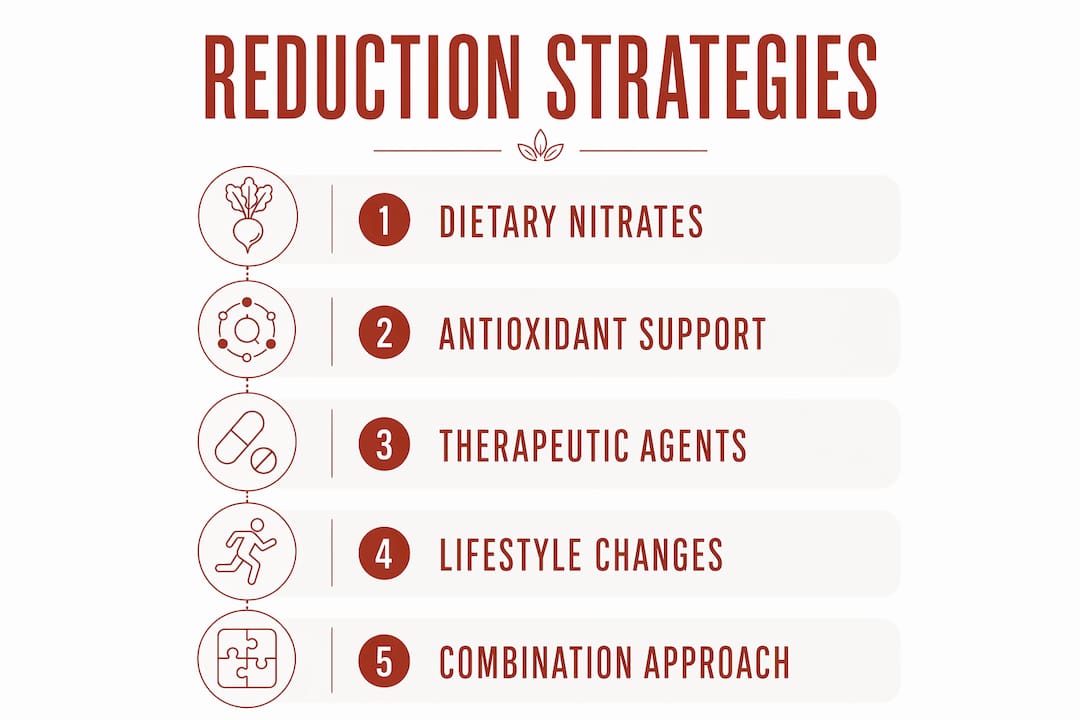
Restoring NO-ROS balance requires a multi-pronged approach. No single intervention addresses all the mechanisms involved. The table below compares the major therapeutic categories:
| Strategy | Mechanism | Limitation |
|---|---|---|
| Dietary nitrates (leafy greens, beets) | Converted to NO via oral bacteria and gut microbiome | Dependent on oral microbiome health; variable conversion rates |
| NO donors (nitroglycerin, sodium nitroprusside) | Directly release NO in tissue | Nitrate tolerance develops with continuous use |
| sGC stimulators (riociguat) | Activate the NO receptor directly, bypassing NO depletion | Prescription only; systemic blood pressure effects |
| PDE5 inhibitors (sildenafil) | Prevent cGMP breakdown, prolonging NO signaling | Narrow therapeutic window; drug interactions |
| BH4 restoration (sapropterin) | Recouples eNOS to restore NO production | Expensive; limited availability outside clinical settings |
| Antioxidant enzymes (SOD support) | Neutralize superoxide before it reacts with NO | Bioavailability of exogenous SOD is a known challenge |
Therapeutic approaches including NO donors and sGC stimulators are clinically validated but carry real limitations. Nitrate tolerance, where the body adapts to continuous NO donor exposure and loses responsiveness, is a well-documented problem with nitroglycerin therapy. This is why restoring endogenous NO production through eNOS recoupling and superoxide reduction is considered the more sustainable goal.
Lifestyle factors matter significantly here. Regular aerobic exercise increases eNOS expression and activity. A diet rich in L-arginine (found in nuts, seeds, and legumes) and L-citrulline (found in watermelon) provides substrate for NO synthesis. Polyphenols from foods like dark chocolate, pomegranate, and green tea support eNOS activity and reduce NOX-driven superoxide production.
Pro Tip: Combining dietary nitrates with antioxidant support addresses two sides of the equation simultaneously: increasing NO substrate while reducing the superoxide that would otherwise destroy it.
The role of superoxide dismutase in heart protection is particularly relevant here. SOD is the cell’s primary enzyme for neutralizing superoxide, acting as the first runner in the antioxidant relay. When SOD activity is sufficient, superoxide is converted to hydrogen peroxide before it can react with NO, preserving the protective signaling pathway.
Common misconceptions about nitric oxide and oxidative stress
Several persistent misunderstandings complicate how people approach NO and oxidative stress in practice.
-
“More NO is always better.” This is false. Boosting NO blindly can worsen oxidative stress because oxidative conditions uncouple NOS, shifting it from NO production to superoxide production. Adding more substrate to an uncoupled enzyme generates more of the problem, not the solution.
-
“Antioxidants alone fix the problem.” Antioxidants reduce ROS load, but they do not recouple eNOS, restore BH4, or address the NOS-NOX feedback loop. They are necessary but not sufficient on their own.
-
“ROS are purely harmful.” Low-level ROS and RNS including NO function as signaling molecules. Beneficial oxidative eustress enables immune defense, cellular adaptation to exercise, and wound healing. The goal is balance, not elimination.
-
“Oxidative stress is the same in every tissue.” Peroxynitrite decomposes differently depending on local pH and CO2 concentration, producing different toxic radicals in different environments. This means the same NO-ROS imbalance can have distinct consequences in cardiac tissue versus neuronal tissue versus the gut.
-
“One supplement solves it.” The NOS-NOX feedback loop, BH4 depletion, and mitochondrial superoxide production are distinct mechanisms. Addressing all of them requires a systems-level perspective, not a single-ingredient fix.
The most accurate framing is that NO is a context-dependent molecule. Its effects depend on concentration, location, duration of exposure, and the surrounding redox environment. Therapy must account for all of these variables.
Key takeaways
Nitric oxide becomes harmful only when oxidative conditions convert it into peroxynitrite, making redox balance the true therapeutic target rather than simply raising or lowering NO levels.
| Point | Details |
|---|---|
| Core mechanism | NO reacts with superoxide to form peroxynitrite, shifting NO from protective to cytotoxic. |
| NOS uncoupling | BH4 depletion causes eNOS to produce superoxide instead of NO, worsening endothelial dysfunction. |
| Disease connection | Cardiovascular disease, neurodegeneration, and diabetes all involve NO depletion and ROS-driven damage. |
| Therapeutic target | Restoring eNOS coupling and reducing superoxide is more effective than simply supplementing NO. |
| Nuanced balance | Low-level ROS and NO serve beneficial signaling roles; the goal is redox balance, not ROS elimination. |
Why I think we’ve been thinking about NO and oxidative stress backwards
Most conversations about nitric oxide focus on how to get more of it. Beet juice, L-arginine powders, and NO-boosting pre-workouts dominate the supplement market. After spending years studying redox biology and working with people managing cardiovascular and metabolic conditions, I’ve come to believe this framing misses the point almost entirely.
The real question is not “how do I raise NO?” It’s “why is my NO being destroyed before it can work?” In most people dealing with chronic disease, the answer is excessive superoxide production from sources like NOX enzymes and dysfunctional mitochondria. Pouring more NO substrate into that environment without addressing the superoxide problem is like filling a leaky bucket. You can keep adding water, but the leak is the actual problem.
What I find genuinely exciting in current research is the focus on NOS recoupling through BH4 restoration and the growing recognition that SOD activity is the upstream gatekeeper of NO bioavailability. If superoxide is neutralized before it reaches NO, the protective signaling pathway stays intact. That is a more elegant and durable solution than any NO donor.
The uncomfortable truth is that personalized approaches are necessary here. The same intervention that helps one person can worsen another’s condition depending on their specific pattern of NOS uncoupling, NOX activity, and antioxidant enzyme status. Redox biology is not a one-size-fits-all domain, and the sooner the supplement industry acknowledges that, the better the outcomes will be.
— Larry
Support your cellular redox health with Tryrevivify
Understanding the NO-ROS relationship is one thing. Giving your cells the tools to maintain that balance daily is another.
At Tryrevivify, we’ve built our supplement around a patented combination of superoxide dismutase and prebiotic fiber. SOD is the enzyme that neutralizes superoxide before it can react with NO and form peroxynitrite. By supporting SOD activity at the cellular level, Tryrevivify addresses the upstream mechanism that determines whether your NO works for you or against you. The prebiotic fiber component supports gut health, which plays a direct role in dietary nitrate conversion and systemic antioxidant capacity. If you’re ready to support your redox balance from the inside out, explore the 30-day supply and see what targeted cellular support looks like in practice.
FAQ
What is nitric oxide oxidative stress in simple terms?
Nitric oxide oxidative stress occurs when NO reacts with superoxide to form peroxynitrite, a toxic compound that damages blood vessels, proteins, and DNA. It represents a shift from NO’s normal protective role to a harmful one driven by excess reactive oxygen species.
Is nitric oxide harmful to the body?
NO is not inherently harmful. At normal concentrations, it supports vasodilation, immune defense, and cellular signaling. Damage occurs only when oxidative conditions convert NO into peroxynitrite, making the surrounding redox environment the determining factor.
What causes nitric oxide levels to drop under oxidative stress?
Superoxide produced by NADPH oxidase and mitochondria reacts with NO faster than antioxidant enzymes can intervene, depleting NO bioavailability. Additionally, BH4 depletion uncouples eNOS, causing it to produce superoxide rather than NO, which compounds the problem.
Can diet reduce nitric oxide oxidative stress?
Yes. Dietary nitrates from leafy greens and beets increase NO substrate, while antioxidant-rich foods and L-citrulline from watermelon support eNOS activity. Combining these with adequate antioxidant enzyme support addresses both sides of the NO-ROS balance equation.
Why don’t antioxidants alone fix oxidative stress?
Antioxidants reduce ROS load but do not recouple eNOS, restore BH4, or interrupt the NOS-NOX feedback loop. Restoring NO balance requires addressing the enzyme-level mechanisms that determine whether NO is produced and preserved, not just scavenging free radicals after the fact.