

Probiotics vs Yogurt: Why Yogurt Leaves a Stronger Microbiome Signal
For most healthy people, probiotic-rich foods like yogurt should be the first move; probiotic supplements earn their place when you need a specific strain for a specific problem. Food-first works best for general gut maintenance, but exceptions matter: post-antibiotic recovery, diagnosed IBS symptoms, or dairy intolerance often call for a targeted supplement instead. Whichever you choose, check quality carefully, and if you’re immunocompromised, talk to a clinician before starting either one.
TL;DR:
- Probiotic supplements offer precisely labeled strains and concentrations, making them suitable for targeted needs like post-antibiotic recovery or diagnosed IBS, unlike yogurt products.
- Regular yogurt benefits overall gut health through nutrient content and consistent microbial exposure but has less predictable probiotic potency and strain specificity.
- A true probiotic must have a documented strain, a defined dose, and evidence showing health benefits at that dose, which most foods and supplements do not always meet.
- For safe and effective use, choose probiotic foods or supplements with clear strain, CFU counts, third-party testing, and proper storage instructions, especially if immunocompromised.
- The best approach is to prioritize food-first, using yogurt for general maintenance, adding targeted supplements only when specific clinical benefits or doses are needed.
Table of Contents
- Probiotics vs Yogurt: A Quick Comparison
- What Actually Counts as a Probiotic?
- What Does the Research Say About Gut-Health Outcomes?
- When Should You Choose Yogurt vs. a Supplement?
- How Do You Know a Probiotic Product Is Safe and Legit?
- How to Start Adding Probiotics to Your Routine
- Where Revivify Fits Into the Food-First Conversation
- A Personal Take on Making This Choice
- Consider Revivify for Targeted Prebiotic Support
- Sources
Probiotics vs Yogurt: A Quick Comparison
Yogurt and probiotic supplements both deliver live microorganisms, but they get there through completely different mechanisms, and that difference shapes who should choose which.
Plain yogurt with “live and active cultures” gives you a food matrix: protein, calcium, B vitamins, and the two starter bacteria required for the yogurt label, Lactobacillus bulgaricus and Streptococcus thermophilus. The catch is potency. Processing steps like heat treatment and long refrigerated storage can knock down live counts, and most yogurt containers don’t disclose colony-forming unit (CFU) numbers at all, so you’re often guessing at dose. A supplement, by contrast, is built around a specific strain or blend, with a labeled CFU count you can actually verify and, ideally, third-party testing to back it up.
That precision comes at a cost, literally and figuratively. Supplements tend to run more expensive per dose than a tub of yogurt, and because the supplement industry isn’t regulated with the same rigor as pharmaceuticals, quality varies wildly between brands. Yogurt, meanwhile, benefits from established food-safety standards, even if its probiotic punch is less predictable.
Here’s how the two stack up on the factors that matter most:
- Strain specificity: Supplements let you target a named strain studied for a particular outcome; yogurt’s live cultures are rarely strain-labeled beyond the two starters.
- CFU transparency: Supplements typically state CFU on the label; yogurt almost never does, and live counts can degrade with age and storage.
- Nutritional package: Yogurt supplies protein, calcium, and B12 alongside its cultures; supplements deliver microbes and little else unless formulated with added ingredients like prebiotic fiber.
- Cost and convenience: Yogurt is cheaper and doubles as food; supplements cost more but travel well and don’t require refrigeration in every case.
- Regulatory oversight: Yogurt falls under standard food-safety rules; supplements are regulated more loosely, making brand reputation and independent testing far more important.
- Best use case: Yogurt suits general daily maintenance for people who tolerate dairy; supplements suit targeted clinical goals, dairy-free needs, or situations requiring a documented dose.
Neither format is universally “better.” The right pick depends on what you’re actually trying to fix, which is exactly what the next sections unpack.
What Actually Counts as a Probiotic?
A probiotic isn’t just “a bacterium that’s supposedly good for you.” The working definition, per the NIH Office of Dietary Supplements, requires three elements: a specific strain, a defined dose, and evidence that dose produces a measurable health benefit. Miss any one of those, and you’ve got a fermented food or a supplement with live bacteria in it, not a probiotic in the clinical sense.
That distinction matters more than most labels let on. The Harvard T.H. Chan School of Public Health makes the point directly: the word “probiotic” shouldn’t be used interchangeably with “fermented food.” A food only earns the probiotic label when research ties its live microbes to a demonstrated benefit at a known dose. Plenty of fermented products, kombucha included, contain live organisms without meeting that bar.
Yogurt’s strains. By law, yogurt sold in the United States needs only two starter cultures, Lactobacillus bulgaricus and Streptococcus thermophilus, to earn the name. Many brands add extra strains, like Lactobacillus acidophilus or Bifidobacterium, and advertise “contains live and active cultures,” but that phrase describes a general category, not a guaranteed clinical dose of any single strain.
Supplement strains. Capsules and powders typically lean on a narrower, better-documented lineup: various Lactobacillus and Bifidobacterium species, plus Saccharomyces boulardii, a yeast strain often used for diarrhea-related issues. These products can list exact CFU counts on the label, which is the whole appeal for anyone chasing a specific, reproducible dose.
A few mechanics worth understanding before you shop:
- CFU stands for colony-forming units, essentially a headcount of live organisms at the time of manufacture, not necessarily at the time you swallow the capsule.
- Survivability depends on the strain, the formulation (some capsules are coated to survive stomach acid), and storage conditions between the factory and your kitchen.
- The food matrix in yogurt, meaning the fats, proteins, and sugars surrounding the bacteria, can actually help some organisms survive digestion better than an isolated capsule does.
- Synbiotics combine probiotics with prebiotic fiber, the food those bacteria eat, in a single product, aiming for a one-two punch rather than relying on microbes alone. Our own breakdown of prebiotics versus probiotics covers this pairing in more depth.
Strain names sound like fine print, but they’re the entire ballgame. Guidelines from the World Gastroenterology Organisation are blunt about it: probiotic effects are species and strain specific, and a product studied for traveler’s diarrhea has no proven bearing on, say, eczema. If you want a deeper look at how individual species behave differently in the gut, our guide to Lactobacillus versus Bifidobacterium walks through what each one actually does.
What Does the Research Say About Gut-Health Outcomes?
The clearest recent evidence comes from two very different angles: population data and biochemistry.
A 2023 cohort study tracking habitual dietary habits found that people who ate yogurt at least once a week showed higher abundance of Streptococcus and lower Odoribacter in their gut microbiome compared to infrequent yogurt eaters. Habitual probiotic supplement use, interestingly, showed no significant association with overall microbial diversity or composition in that same cohort. That doesn’t mean supplements don’t work; it means their effects may be more targeted and transient than the steady, cumulative shift that comes from eating a fermented food regularly over years.
Yogurt’s chronic exposure appears to leave a more visible fingerprint on the resident microbiome than occasional supplement use does, at least at the population level.
The biochemistry backs up a related but distinct story. Metabolomic research comparing the two head-to-head found genuinely different chemical signatures. Probiotic supplements correlated with higher in vitro antioxidant and antiglycation activity, along with elevated amino acids and indole derivatives; these compounds are linked to microbial protein metabolism. Yogurt, on the other hand, showed higher relative abundances of carbohydrates, acylcarnitines, and metabolites like butyrate and creatine, butyrate being the short-chain fatty acid most closely tied to colon health and a favored energy source for gut lining cells.
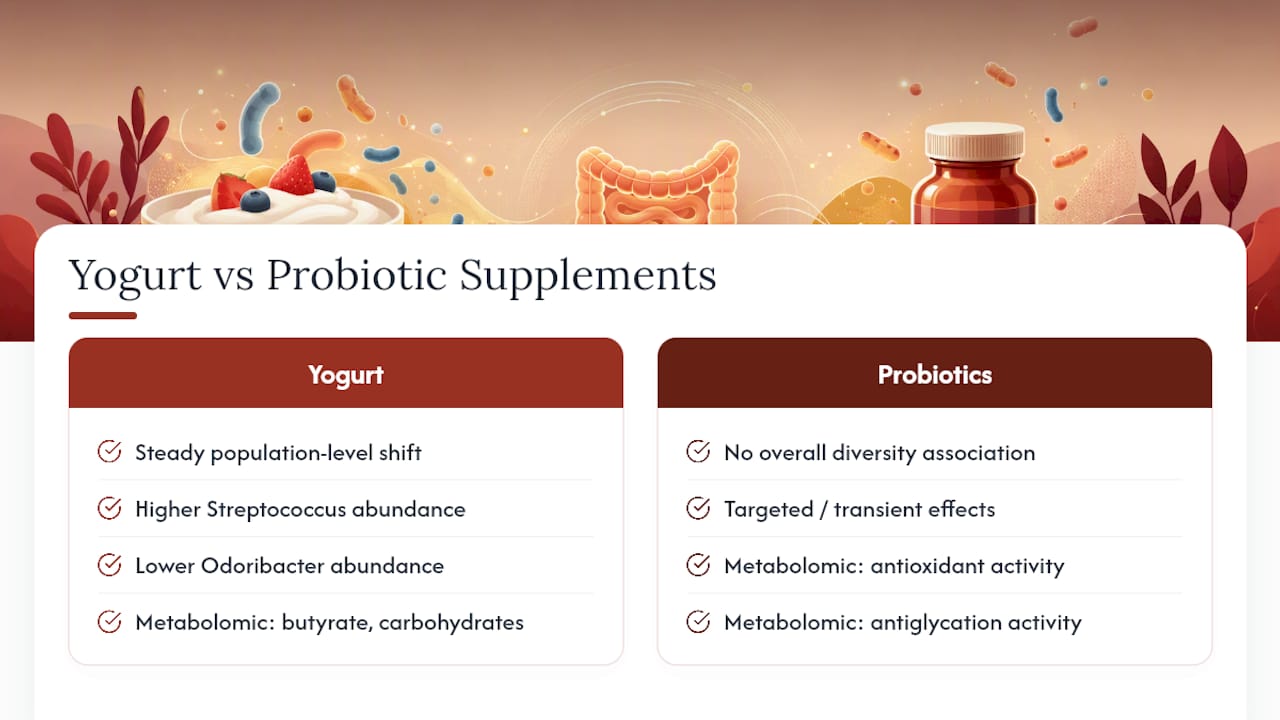
Put simply: supplements and yogurt aren’t interchangeable inputs that produce the same output. They nudge your body’s chemistry in different directions, which is exactly why “probiotics vs yogurt” doesn’t have one universal winner. The right answer depends on which of those directions matches your goal.
Where does the clinical trial evidence hold up best? Antibiotic-associated diarrhea is probably the strongest case for supplements. Specific strains, particularly Saccharomyces boulardii and certain Lactobacillus species, have reasonably consistent trial support for reducing diarrhea risk during antibiotic courses. Some IBS symptom endpoints, like bloating and stool consistency, also show benefit from strain-specific supplements, though results vary by product and by which IBS subtype a person has.
What remains genuinely uncertain is broader than what’s settled. Research on probiotics for immune function, mood, skin conditions, and general “gut health” maintenance is inconsistent, partly because trials use different strains, different doses, and different populations, making them hard to compare directly. Product heterogeneity is the recurring theme across this literature: a positive result for one branded strain blend tells you almost nothing about a different product on the shelf next to it, even if both say “probiotic” on the label.
When Should You Choose Yogurt vs. a Supplement?
Decision paralysis usually comes from treating this as an either-or question when it’s really a matching exercise: match the tool to the goal.
- General daily maintenance and overall wellness. If you’re not chasing a specific symptom, plain yogurt or another fermented food you tolerate is the sensible default. Harvard Health and other academic sources consistently recommend food-first approaches for healthy adults, largely because fermented foods bring nutrients and prebiotic fiber that isolated capsules don’t.
- Post-antibiotic recovery or diagnosed IBS symptoms. This is where strain-specific supplement evidence is strongest. Look for a product with a named, clinically studied strain rather than a generic blend, and give it a few weeks before judging results.
- Dairy intolerance, vegan diets, or a need for precise dosing. If lactose or casein is off the table, or you need a documented, consistent dose for a clinical reason, a supplement or a non-dairy fermented option (think coconut-milk yogurt or fermented vegetables) fills the gap yogurt can’t.
- Combining both. Plenty of people use yogurt for daily maintenance and layer in a targeted supplement during a specific flare or after a round of antibiotics. There’s no rule against running both approaches at once.
Before you commit to either path, run through a short checklist: How well do you tolerate dairy and fermented foods generally? What specific outcome are you targeting, or is this just general upkeep? What’s your budget, since supplements cost more per dose than yogurt? And if you’re pregnant, immunocompromised, elderly, or managing a chronic illness, has a clinician weighed in?
Pro Tip: If you’re not sure which camp you fall into, start with yogurt for two weeks and note how you feel. If nothing improves and you have a specific symptom in mind, that’s your cue to research a strain-specific supplement instead of switching products randomly.
How Do You Know a Probiotic Product Is Safe and Legit?
Supplements and foods play by different rulebooks, and understanding that gap is the single best way to avoid wasting money on something useless.
Yogurt operates under standard food-safety regulation, which covers contamination and labeling basics but says nothing about how many live organisms survive to the point of sale. The Food Safety Institute notes that only the two starter cultures are legally required for the yogurt name; everything else, including any added probiotic strains, is discretionary and inconsistently disclosed.
Supplements face a different problem. The NIH is direct about this: dietary supplements aren’t regulated with the same rigor as drugs, so what’s printed on the label doesn’t always match what’s actually in the bottle. That’s exactly why third-party testing matters so much; independent verification is one of the few practical checks a consumer has against mislabeled potency or contamination.
Watch for these warning signs when you’re evaluating either format:
- No named strain, just “probiotic blend.” A generic blend with no species or strain identifiers tells you almost nothing about what it actually does.
- Vague or absent CFU counts. If a supplement won’t disclose a number, or the number seems implausibly high with no context, be skeptical.
- Sweeping health claims. A capsule that promises to cure a dozen unrelated conditions is a marketing red flag, not a research finding.
- Heat-treated or “may contain live cultures” yogurt. Some products are pasteurized after culturing specifically to extend shelf life, which kills the very organisms you’re buying it for.
- No storage guidance. Legitimate probiotic products, food or supplement, usually specify refrigeration or shelf-stable handling; silence on this point suggests the manufacturer hasn’t tested for survivability.
Certain groups need extra caution regardless of format: people who are immunocompromised, critically ill, very young, or elderly should talk to a clinician before starting a new probiotic supplement, since rare cases of bacterial or fungal infections from probiotic organisms have occurred in vulnerable patients, per Mayo Clinic guidance. This caution extends to anyone undergoing active cancer treatment; the Hippocratic Cancer Research Foundation’s patient guide covers specific supplement interactions worth discussing with an oncology team before adding anything new, probiotics included.
How to Start Adding Probiotics to Your Routine
Testing this yourself beats reading about it, and it doesn’t require a complicated protocol.
- Start with food. Pick a plain Greek yogurt labeled “contains live and active cultures,” skip the added-sugar varieties, and pair it with a fiber source like oats or berries. Fiber feeds the bacteria you’re introducing, which our guide to feeding beneficial gut bacteria covers in practical detail.
- If you move to a supplement, choose deliberately. Look for named strains, a disclosed CFU count, and third-party testing. Start with one product, not a stack of three, so you can actually tell what’s working. Our roundup of gut microbiome support supplements breaks down what quality labeling looks like.
- Give it four to eight weeks. Microbiome shifts take time. Track digestion, bloating, energy, and bowel regularity in a simple note or app rather than relying on memory. If you’re traveling during your trial, heat and humidity can degrade some formulations, so check storage stability before you pack a probiotic in a hot car or suitcase.
Refrigerate yogurt properly and follow label storage instructions for supplements exactly. Some capsules need refrigeration, others don’t, and guessing wrong shortens their shelf life fast.
Where Revivify Fits Into the Food-First Conversation
Our position at Tryrevivify has never been “skip the yogurt, buy a pill.” The research backs a food-first approach for most healthy people, and we say so plainly, even though we sell a supplement. Fermented foods bring nutrients and context that isolated microbes can’t replicate on their own.
Where a targeted supplement earns its place is when the goal is specific: dairy intolerance, a documented need for a consistent dose, or wanting prebiotic fiber alongside antioxidant support in one routine. That’s the gap our own formula is built to address, combining prebiotic fiber with additional support ingredients rather than trying to be a yogurt replacement.
If you want to go deeper on strain differences before deciding anything, our breakdown of beneficial gut bacteria types and our guide on timing probiotic intake are both good next stops.
A Personal Take on Making This Choice
There’s no single right answer here, and anyone selling you one is oversimplifying real biology. The decision rule that actually holds up: default to yogurt or another tolerated fermented food for daily maintenance, and reach for a strain-specific supplement only when you have a defined problem to solve.
If you fall into a special population, pregnant, immunocompromised, managing a chronic illness, skip the guesswork and loop in a clinician first. Otherwise, run your own four to eight week trial, track what actually changes, and let your own data settle the argument.
— Larry
Consider Revivify for Targeted Prebiotic Support
If you’ve decided a supplement makes more sense than yogurt for your situation, whether that’s dairy intolerance, wanting a consistent daily dose, or simply preferring capsule convenience over managing a fridge full of yogurt tubs, Revivify offers a different kind of support than a standard probiotic capsule.
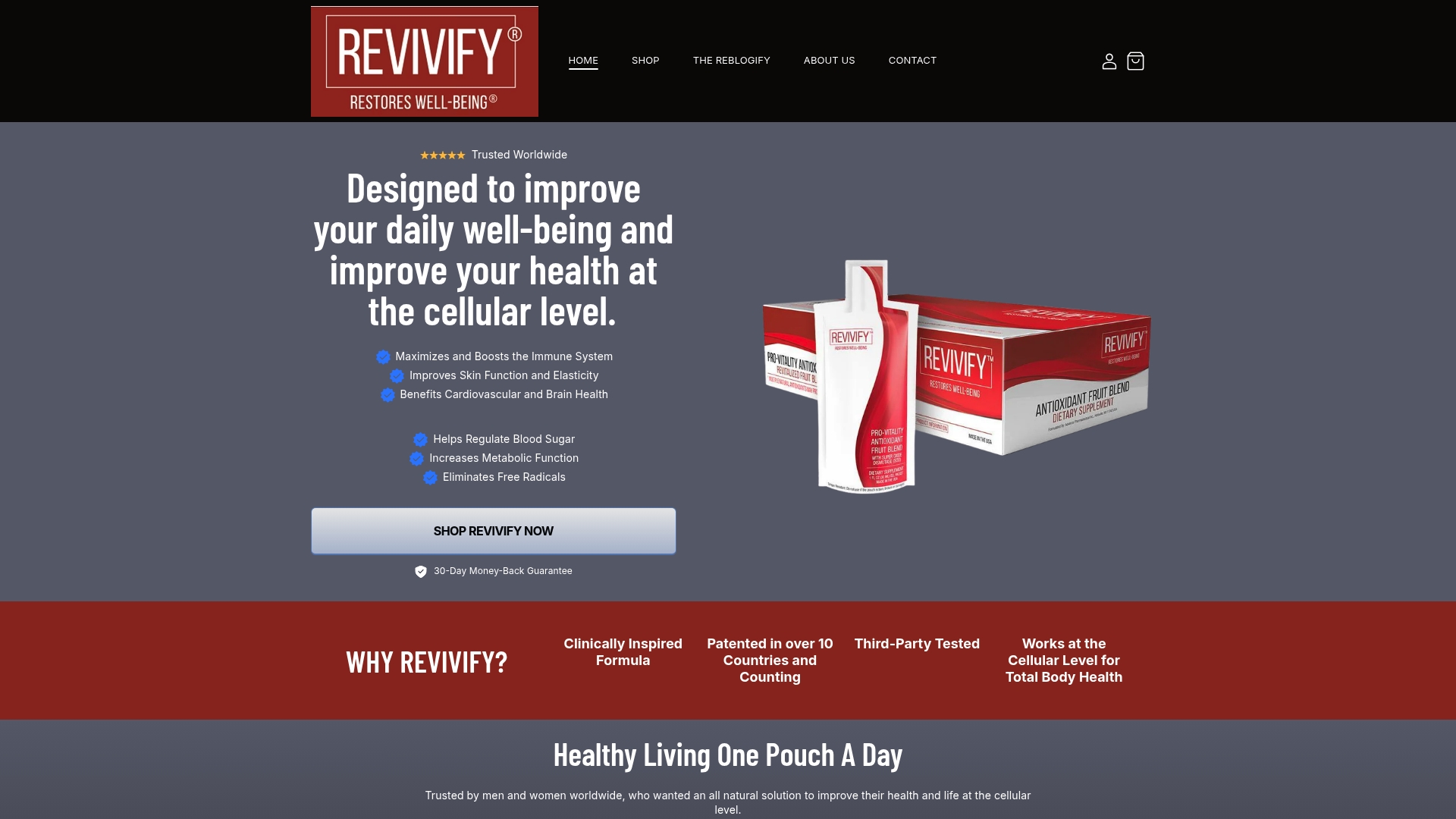
This supplement combines prebiotic fiber with antioxidant enzymes, polyphenols, and lactobacillus in a plant-based gel formula, third-party tested and designed to support digestion and cellular health together rather than isolating one microbe strain. It’s a fit for readers who want consistent daily dosing without relying on refrigerated food, or who are managing dairy intolerance and still want fiber-based support for the bacteria already living in their gut. The formula also offers options for ongoing purchase and a satisfaction guarantee to support customer confidence. If targeted, consistent support sounds like the missing piece in your routine, you can see the full Revivify formula and check current subscription pricing.
This article is general information, not a substitute for advice from a qualified doctor. Consult a qualified healthcare professional about your own circumstances before acting on anything here.
Sources
- Association of habitual intake of probiotic supplements and yogurt with characteristics of the gut microbiome — 2023
- NIH Office of Dietary Supplements — Probiotics fact sheet
- Harvard Health Publishing — Want probiotics but dislike yogurt? Try these foods