

Cut LDL 5.6 mg/dL Per 5 g: Soluble Fiber, Meals, and Safe Supplements
Soluble fiber lowers LDL cholesterol by about 8 mg/dL on average, with each additional 5 grams a day adding further reduction, according to a dose-response meta-analysis of randomized trials. The practical target most researchers point to is 5 to 10 grams of soluble fiber daily on top of what you already eat. Expect measurable movement within weeks to a couple of months, and treat it as one lever among several, not a standalone fix.
TL;DR:
- Adding 5 grams of soluble fiber daily can lower LDL cholesterol by approximately 5.6 mg/dL, with greater benefits up to 10 grams.
- The most effective fibers are viscous types like psyllium and β-glucan, which form gels that trap bile acids and promote cholesterol excretion.
- Larger reductions are seen in individuals with high cholesterol or type 2 diabetes, but results vary due to differences in fiber type, dose, and study duration.
- It typically takes 4 to 12 weeks of consistent intake to observe meaningful LDL reductions, especially when gradually increasing fiber consumption.
- Fiber supplements should be used with caution when on medications, especially bile-acid sequestrants, to avoid binding and absorption issues.
Table of Contents
- What does soluble fiber cholesterol research actually show?
- How does soluble fiber actually lower LDL?
- Which soluble fibers and foods work best?
- How much soluble fiber should you add, and how fast?
- How soon will your cholesterol numbers actually change?
- What side effects and drug interactions should you watch for?
- What does a soluble fiber day actually look like?
- What actually moves the needle on cholesterol?
- Where prebiotic fiber supplements fit into this plan
- Sources
What does soluble fiber cholesterol research actually show?
A 2023 dose-response meta-analysis pooled randomized controlled trials testing soluble fiber supplementation against control diets. The headline numbers are specific: LDL cholesterol fell on average, and total cholesterol dropped notably. What makes this analysis useful beyond a single average is the dose-response curve embedded in it. Every additional 5 grams of soluble fiber per day tracked with further LDL and total cholesterol reductions. That is not a plateau effect where the first few grams do all the work. More fiber, within the studied range, kept producing more benefit.
Older research told a similar story from a different angle. A body of meta-analytic work, including a widely cited review that helped establish the American Heart Association’s early framing of fiber’s role in lipid management, found that viscous, water-soluble fibers such as β-glucan, psyllium, pectin, and guar gum lower total and LDL cholesterol by about 5 to 10 percent, largely without moving HDL or triglycerides much in either direction. Translate that percentage into real numbers: someone starting with an LDL of 160 mg/dL could reasonably expect a drop of 8 to 16 mg/dL from consistent soluble fiber intake alone. That range overlaps neatly with the newer dose-response figures.
The effect is not uniform across every person. Subgroup data consistently show larger reductions in people who start with hyperlipidemia and in those managing type 2 diabetes, where baseline LDL and triglycerides tend to run higher and have more room to move. That is an encouraging pattern for the people who arguably need it most, but it comes with a caveat researchers are careful to state.
Certainty and heterogeneity: the trials included in these meta-analyses vary widely in fiber type, dose, study duration, and baseline diet, which introduces real statistical heterogeneity. That does not undermine the core finding. It does mean individual results will vary, and a single fiber source tested for eight weeks in one trial is not identical to a mixed-fiber approach followed for six months.
A few numbers worth anchoring on:
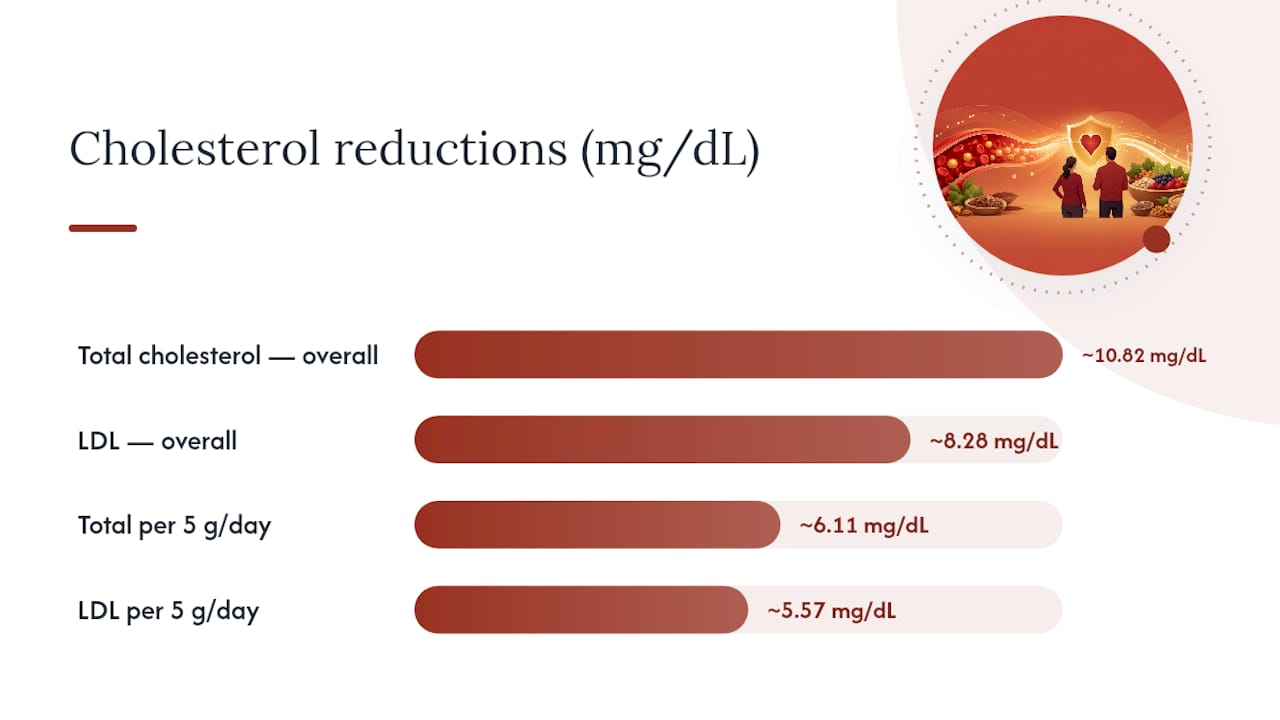
- LDL reduction: ~8.28 mg/dL overall, ~5.57 mg/dL per additional 5 g/day
- Total cholesterol reduction: ~10.82 mg/dL overall, ~6.11 mg/dL per additional 5 g/day
- Viscous soluble fibers broadly: 5 to 10 percent reduction in LDL and total cholesterol
- Larger effects observed in hyperlipidemia and type 2 diabetes subgroups
The numbers that matter: every 5 grams of soluble fiber added to a daily diet tracks with roughly 5.6 mg/dL less LDL cholesterol, based on pooled randomized trial data.
Soluble fiber’s benefit does not stop at lipids, either. Higher fiber intake correlates with lower C-reactive protein and reduced systemic inflammation in cohort studies, which matters for heart health independent of cholesterol numbers. And for readers already on statins or other cardioprotective medication, trial data suggest fiber still adds benefit on top of standard therapy rather than getting canceled out by it.
How does soluble fiber actually lower LDL?
Soluble fiber doesn’t lower cholesterol through a single mechanism. It works through three overlapping processes, and understanding them explains why some fibers work better than others.
Viscous gel formation traps bile acids. When soluble fiber hits water in your gut, it swells into a thick, gel-like substance. Think of it as a net cast through your intestines. That gel physically traps bile acids and dietary cholesterol, carrying both out in stool instead of letting them get reabsorbed and recirculated back to the liver.
Your liver compensates by pulling LDL out of your blood. Bile acids are made from cholesterol. When you excrete more of them because fiber trapped them, your liver has to manufacture more bile acid to keep up, and it uses cholesterol from your bloodstream to do it. To get that cholesterol, the liver ramps up LDL receptors on its cell surface, pulling LDL particles out of circulation. This is the same receptor pathway statins target, just triggered by a different upstream mechanism.
Fermentation produces short-chain fatty acids that may dial down cholesterol production. Not all soluble fiber forms a gel. Some gets fermented by gut bacteria into short-chain fatty acids, propionate among them, which some research suggests interferes with cholesterol synthesis in the liver. This pathway is less firmly established than the bile-acid mechanism, but it likely contributes to the broader metabolic benefits tied to high-fiber diets, including the inflammation reductions mentioned earlier.
Here’s the part most articles skip: not every fiber is equally good at this job.
- Viscosity and molecular weight determine how well a fiber gels and binds bile acids.
- Medium-to-high molecular-weight fibers like psyllium and oat β-glucan form robust gels; low-viscosity fibers barely register on cholesterol.
- A supplement labeled simply “fiber” without naming a viscous type may do very little for your lipid panel.
- Cooking, processing, and particle size can all reduce a fiber’s effective viscosity.
Pro Tip: Check supplement labels for the specific fiber name, psyllium husk or oat β-glucan, and the grams per serving. “Fiber blend” on a label is a red flag that the viscous, cholesterol-active dose might be small.
Which soluble fibers and foods work best?
Four fiber types carry the bulk of the clinical evidence: β-glucan, psyllium, pectin, and guar gum. Each shows up repeatedly in the trials behind the meta-analyses above, and each has a distinct food source and viscosity profile worth knowing.
β-glucan is the soluble fiber in oats and barley, and it’s the most-studied cholesterol-lowering fiber on the market. A cup of cooked oatmeal delivers roughly 2 to 3 grams of soluble fiber; steel-cut and old-fashioned oats generally edge out instant varieties because less processing preserves more of the gel-forming structure.
Psyllium comes from the seed husk of Plantago ovata and is uniquely useful because it delivers a consistent, measured dose whether from food or supplement form. A tablespoon of psyllium husk provides around 4 grams of soluble fiber, which is why it’s the fiber most often used in clinical trials when researchers want a controlled dose.
Pectin is abundant in apples, citrus fruit, and berries. A medium apple with the skin on carries roughly 1 gram of soluble fiber, less concentrated than oats or psyllium but easy to layer into daily eating without thinking about it.

Guar gum shows up mostly as a food additive and in some fiber supplements. It’s highly viscous gram for gram, though it’s less commonly found in whole foods most people eat regularly.
Beyond these four, legumes deserve a mention: a half-cup of cooked beans or lentils typically contributes 2 to 3 grams of soluble fiber alongside plant sterols and other compounds that support heart health on their own.
- Oats and barley (β-glucan): ~2–3 g soluble fiber per cooked cup
- Psyllium husk: ~4 g soluble fiber per tablespoon
- Apples, citrus, berries (pectin): ~1 g soluble fiber per medium fruit
- Beans and lentils: ~2–3 g soluble fiber per half-cup cooked
- Guar gum: concentrated, mostly found in additives and supplements
Mayo Clinic’s guidance on cholesterol-lowering foods echoes this food-first approach, recommending oats, beans, fruit, and vegetables as the primary route to the 5 to 10 gram target. Supplements earn their place when whole foods can’t close the gap, whether from appetite limits, GI sensitivity to legumes, or a schedule that makes three fiber-rich meals a day unrealistic. If you go that route, look for a labeled dose of psyllium or β-glucan specifically, not a vague “fiber blend,” and drink a full glass of water with it. Viscous fiber without enough fluid can feel like swallowing paste, and it won’t gel properly in your gut either.
How much soluble fiber should you add, and how fast?
Jumping straight to 10 grams of new fiber on day one is a reliable way to spend the next 48 hours regretting it. A staged approach works better and mirrors how the successful trials structured their protocols.
- Week 1: Add 2 to 3 grams of soluble fiber daily. A bowl of oatmeal at breakfast or a half-cup of beans at lunch gets you there without much digestive protest.
- Week 2: Push to the full 5 gram mark. Add a second source, an apple with lunch or a tablespoon of psyllium mixed into water or a smoothie.
- Week 3 and beyond: Hold at 5 grams if that’s working, or continue building toward 10 grams if your goals and your gut tolerance both support it. This is roughly where the meta-analysis data suggests the strongest additional LDL benefit shows up.
Track what you’re doing, at least loosely. A simple note on your phone, “oats + beans today,” is enough to spot patterns if something isn’t sitting well or if you plateau below your target. If you’re managing diabetes, taking cholesterol medication, or dealing with an existing GI condition like IBS or diverticulitis, loop in a dietitian or your physician before ramping up. They can help sequence fiber changes around your medications and flag anything your specific health picture requires extra caution on.
Pro Tip: Spread your fiber additions across two or three meals instead of loading it all into one. Your gut bacteria adjust to fermentable fiber gradually, and spacing it out reduces the bloating that comes from asking your microbiome to process a week’s worth of change in one sitting.
How soon will your cholesterol numbers actually change?
Most people who add soluble fiber consistently see measurable LDL movement within 4 to 12 weeks, based on the duration of trials feeding the dose-response meta-analysis. Longer trials, six months and beyond, tend to show somewhat larger reductions than the shorter ones, suggesting the effect builds rather than maxing out immediately.
In practical terms, a sustained 5 to 10 gram daily increase points toward roughly 5 to 10 percent LDL reduction over that window, consistent with the older viscous-fiber meta-analyses. On a starting LDL of 140 mg/dL, that’s a plausible 7 to 14 mg/dL drop, worth discussing in the context of your overall cardiovascular risk rather than as an isolated number.
A sensible testing rhythm:
- Get a baseline lipid panel before making changes.
- Retest at 8 to 12 weeks once you’ve held a consistent fiber increase.
- Follow up periodically after that, particularly if you’re adjusting doses or combining fiber with other dietary or medication changes.
Fiber’s effect compounds with consistency. A week of oatmeal followed by three weeks of drive-through breakfasts won’t show up on a lipid panel the same way steady daily intake does.
What side effects and drug interactions should you watch for?
The most common downside of adding soluble fiber is gas, bloating, or cramping, particularly in the first two weeks. This is your gut microbiome adjusting to a new fermentation substrate, and it’s almost always temporary.
- Increase fiber gradually over 1 to 3 weeks rather than all at once.
- Drink more water. Viscous fiber needs fluid to form its gel properly and move through your system comfortably.
- Spread fiber sources across meals instead of concentrating them in one sitting.
- If symptoms persist past a few weeks, dial back the dose and rebuild more slowly.
Medication timing deserves specific attention. Because viscous fiber binds things in the gut, it can also bind certain oral medications and reduce how much your body absorbs. The NIH’s dietary fiber guidance recommends separating fiber supplements from oral medications by a couple of hours as a general precaution. This matters most with bile-acid sequestrant drugs, which work through a mechanism that overlaps with fiber’s own bile-binding action, and your clinician should guide dosing timing if you’re on one.
Check with a doctor before making significant changes if you’re pregnant, managing a complex medication regimen, or living with an existing GI disorder like Crohn’s disease or diverticulitis. Clinical explanations of fiber’s role in digestion are worth a read if you want a deeper look at how fiber interacts with gut motility beyond the cholesterol angle.
What does a soluble fiber day actually look like?
- Breakfast: A cup of cooked oatmeal topped with a sliced apple, roughly 3 to 4 grams of soluble fiber before 9 a.m.
- Lunch: A half-cup of black beans added to a salad or grain bowl, another 2 to 3 grams.
- Snack: A tablespoon of psyllium husk stirred into water or a smoothie, about 4 grams in one hit.
- Dinner swap: Replace a refined side with a half-cup of lentils or barley, adding 2 to 3 more grams.
Shopping list: rolled or steel-cut oats, canned or dried black beans and lentils, apples and citrus, barley, and psyllium husk powder if you’re supplementing. Ramp up over two to three weeks as outlined earlier, and keep water intake up throughout. A body adjusting to more fermentable fiber needs more fluid than one on a low-fiber baseline, full stop.
What actually moves the needle on cholesterol?
Here’s what the evidence doesn’t fully capture: the biggest failure point for soluble fiber isn’t the science, it’s follow-through. The dose-response data is about as clean as nutrition research gets, but every trial behind it involved people who took a defined amount of fiber every day for weeks or months. Real life is messier, and that gap between trial adherence and everyday habit is where most of the promised benefit quietly disappears.
I’d also push back gently on the framing that treats fiber as a cholesterol pill substitute. It isn’t one, and the trials showing continued benefit in people already on statins make that clear. Fiber works alongside medication and other heart-healthy habits, not instead of them. The people who get the most out of it are the ones who stop treating 5 grams a day as a chore and start treating it as a permanent swap, oats instead of a bagel, beans instead of white rice.
If you want to go deeper on how fiber affects inflammation markers, Tryrevivify’s piece on fiber and gut inflammation is worth your time, as is the look at prebiotic fiber and diabetes management for readers managing blood sugar alongside lipids. Whatever you take from this, take the consistency point most seriously. Talk to your clinician before layering fiber onto existing medication, and let food do the heavy lifting before you reach for a supplement aisle.
— Larry
Where prebiotic fiber supplements fit into this plan
Whole foods should always be your first move toward that 5 to 10 gram target, but plenty of people fall short on days when oatmeal and lentils aren’t realistic. That’s the gap a daily supplement is built to close, not replace. A gel-based formula can combine prebiotic soluble fiber with superoxide dismutase, polyphenols, and lactobacillus, giving a fermentable fiber source alongside broader antioxidant and gut-health support in one daily serving.
It fits easily into a morning or evening routine, one serving with a full glass of water, ideally spaced a couple of hours from any oral medication as a general precaution. It is plant-based and third-party tested. If you’re on cholesterol medication or managing another chronic condition, run it by your clinician first, the same way you would any new supplement. The product is offered with a risk-free guarantee and subscription pricing to support consistent usage. Head to the Revivify product page to see current options and get started.
This article is general information, not a substitute for advice from a qualified doctor. Consult a qualified healthcare professional about your own circumstances before acting on anything here.
Sources
- Soluble Fiber Supplementation and Serum Lipid Profile: A Systematic Review and Dose-Response Meta-Analysis of Randomized Controlled Trials
- Cholesterol-lowering effects of dietary fiber: a meta-analysis
- Dietary fiber: definitions and guidance (NLM/NIH resource)