

Why Delivery and IU Activity Matter for Superoxide Dismutase on Skin
Superoxide dismutase is an enzymatic antioxidant that can measurably reduce UV-induced skin damage, from erythema to inflammatory cell death. That benefit only shows up when the enzyme actually reaches living skin cells intact, which means the delivery system and formulation matter as much as the ingredient itself. Think of SOD as a prevention and maintenance tool, not a wrinkle eraser you’ll see working overnight.
TL;DR:
- Topical SOD effectiveness depends on formulations with encapsulation or peptide carriers that ensure enzyme stability and skin penetration.
- Shielding packaging from light and air is crucial to preserve SOD activity in skincare products, which are typically measured in IU for functional strength.
- Clinical evidence shows SOD can reduce UV-induced erythema and inflammatory cell death but small trials and co-ingredients limit definitive claims.
- Applying SOD after cleansing and pairing it with sunscreen enhances protection, but expect visible results only over months of consistent use.
- Systemic oral SOD supplements provide internal support for oxidative stress, complementing topical treatments but targeting different health goals.
Table of Contents
- What Is Superoxide Dismutase and How Does It Protect Skin?
- What Does Human Clinical Evidence Show?
- How Is SOD Formulated for Topical Use?
- How Do You Choose and Layer an SOD Skincare Product?
- Oral SOD Supplements vs. Topical: Which Approach Fits Your Goal?
- Why Delivery Science Should Drive Your Buying Decisions
- A Systemic Option Worth Knowing About
- Sources
What Is Superoxide Dismutase and How Does It Protect Skin?
Superoxide dismutase catalyzes one specific reaction: it converts superoxide radicals into hydrogen peroxide and oxygen. That sounds like a lateral move since hydrogen peroxide is also reactive, but your skin has downstream enzymes like catalase that finish the cleanup. SOD is the first runner in a relay team, handing off a dangerous radical before it can damage lipids, proteins, or DNA in skin cells.
Three isoforms exist in the body, and they matter differently for skincare:
- SOD1 works inside the cytoplasm of cells, managing internal oxidative load.
- SOD2 operates in mitochondria, the cell’s energy centers where oxidative stress originates.
- SOD3 sits in the extracellular matrix, which puts it in direct contact with collagen and the skin’s structural scaffolding.
That extracellular position makes SOD3 the isoform most relevant to topical outcomes, since it’s already stationed where UV-generated free radicals attack collagen fibers. Less superoxide floating around the matrix means less activation of matrix metalloproteinases, the enzymes that chew through collagen after sun exposure. Research on SOD localization in human skin also shows Cu/Zn SOD activity concentrated in keratinocytes, and that activity tends to drop with age and chronic sun exposure. Fewer defenders on duty, more damage that sticks.
What Does Human Clinical Evidence Show?
The mechanistic case for SOD is strong. The human clinical case is real but thin, and any honest answer to “does this work on skin” has to say both things at once.
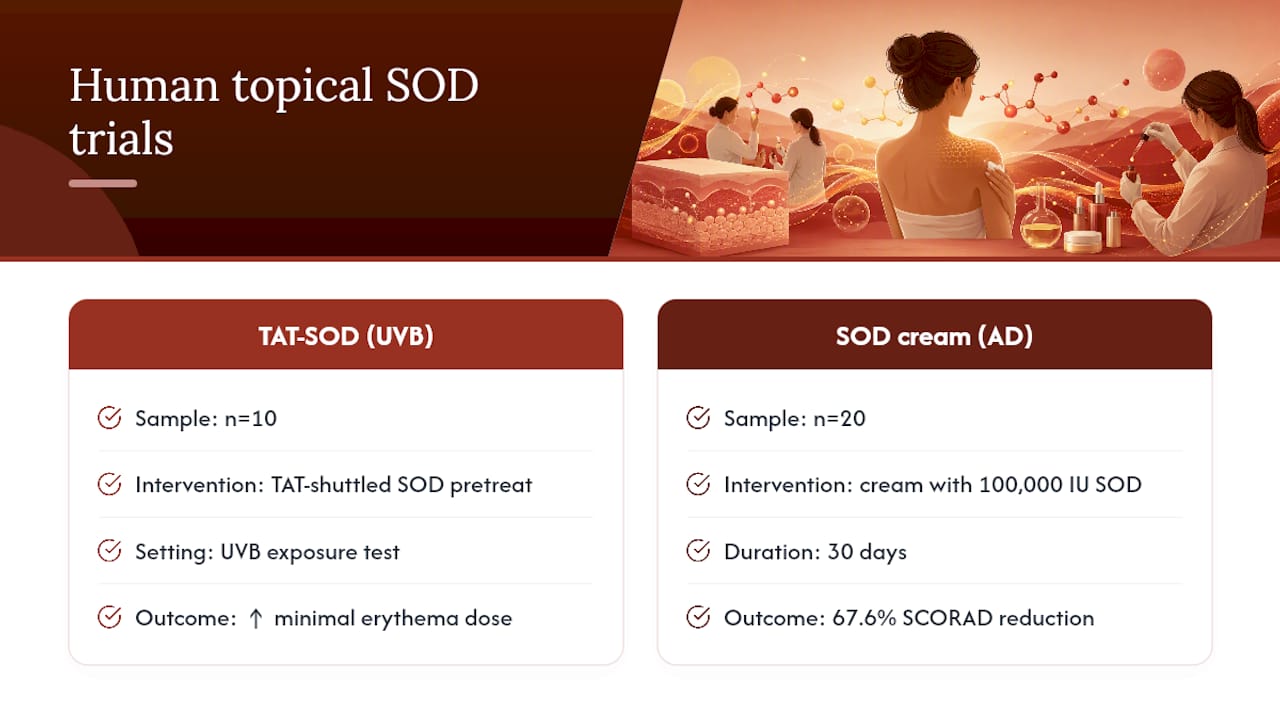
The most cited topical trial used a cell-penetrating peptide called TAT to shuttle SOD past the stratum corneum. In that study, pretreating skin with TAT-SOD before UVB exposure increased the minimal erythema dose substantially and cut apoptotic sunburn cells markedly. The sample was small (n=10), but the result matters because it isolates SOD’s effect using a delivery method built to solve the enzyme’s biggest weakness: its size.
A separate trial looked at inflammatory skin rather than sun damage. Over 30 days, a cream combining 100,000 IU of SOD with plant extracts produced a 67.6% reduction in SCORAD scores among 20 participants with atopic dermatitis. That’s a striking number, but the plant extracts in the formula make it impossible to credit SOD alone for the improvement.
Broader review literature backs the mechanism more confidently than it backs specific products. Most supporting data still comes from in vitro or animal models. Human trials remain few, small, and often confounded by co-ingredients, which is the honest state of the evidence in 2026.
How Is SOD Formulated for Topical Use?
SOD’s biggest obstacle isn’t whether it works. It’s whether it survives the jar and then survives your skin barrier. This is a large, folded protein, and proteins denature under heat, shift pH, and get chewed apart by proteases before they ever touch a keratinocyte.
Cosmetic formulations typically land in one of two measurement systems. Some brands list a straightforward percentage, commonly 0.1% to 1%. Others report enzymatic activity in International Units (IU), which reflects the functional activity of the enzyme rather than just protein mass. IU is the more meaningful number, since a degraded enzyme can still show up as a percentage on an ingredient list while doing nothing.
Stability comes down to a few practical factors:
- Heat exposure during manufacturing or storage denatures the enzyme’s active site.
- Low pH formulations can unfold the protein structure.
- Opaque, airless packaging limits oxidative and light-driven breakdown.
- Encapsulation in liposomes or niosomes protects SOD from degradation and helps it move through skin’s outer layers more intact than an unprotected enzyme would.
The cell-penetrating peptide approach used in the TAT-SOD trial has the strongest mechanistic rationale and human backing among delivery strategies tested so far, precisely because it was designed to solve the penetration problem rather than assume it away.
Pro Tip: If a product’s label only lists a percentage with no mention of encapsulation, liposomes, or a peptide carrier, treat the claim skeptically. A protein this size doesn’t cross the skin barrier just because it’s in the formula.

How Do You Choose and Layer an SOD Skincare Product?
Reading past the front-of-bottle marketing takes about thirty seconds once you know what to look for.
- Check the INCI list for “superoxide dismutase” and note whether it’s paired with delivery language like liposomal, encapsulated, or peptide-conjugated.
- Look for IU activity rather than just a percentage, since activity reflects function, not just presence.
- Confirm packaging is opaque and airless. Clear jars exposed to light and air are a red flag for enzyme stability.
- Apply after cleansing, before heavier occlusives, so the serum or gel reaches skin before it’s sealed under a thick moisturizer.
- Pair with sunscreen in the morning. SOD supports your skin’s defense system; it doesn’t replace UV filters.
- Skip layering with strong actives like retinoids or high-percentage acids on the same night if your skin is already reactive.
Set your timeline expectations around prevention and maintenance, measured in months, not days. Any product promising visible wrinkle reversal in a week is overselling what this ingredient class, supported by clean safety data at cosmetic concentrations, can realistically deliver.
Oral SOD Supplements vs. Topical: Which Approach Fits Your Goal?
Oral and topical SOD solve different problems. Swallowed SOD faces its own barrier: digestive enzymes break down the protein before much of it reaches circulation intact, which is why some manufacturers use gliadin-conjugation to help it survive the gut. Topical SOD, by contrast, works locally on the skin it touches, which is exactly where UV and pollution damage originates.
- Topical SOD targets localized oxidative stress right where sun exposure and environmental stressors hit hardest.
- Oral SOD aims for systemic antioxidant support, functioning alongside the body’s broader inflammatory and cellular defense network rather than concentrating on skin alone.
- Combining both makes sense only if you understand you’re targeting two different goals, not doubling up on one.
There’s no need to choose only one if your goals span both local skin defense and overall systemic support.
Why Delivery Science Should Drive Your Buying Decisions
Most skincare marketing treats SOD as if listing it on a label is the whole story. It isn’t. At Tryrevivify, our focus on formulation and delivery challenges comes directly from watching how often strong mechanistic and animal data gets flattened into a bottle that can’t actually deliver an intact enzyme to skin cells. The gap between “SOD works in a lab” and “this serum works on your face” is where most product claims quietly fall apart. For readers who want the supplement side of this story, our guide to SOD supplements covers formulation and safety in more depth.
— Larry
A Systemic Option Worth Knowing About
Topical SOD works locally, on the skin it touches, which is powerful but limited to whatever a serum or cream can physically reach. There is an alternative approach using a daily gel supplement that pairs SOD with prebiotic fiber, polyphenols, and lactobacillus to support the body’s antioxidant defenses from the inside, at the cellular level, rather than trying to solve the same penetration problem every topical product faces.
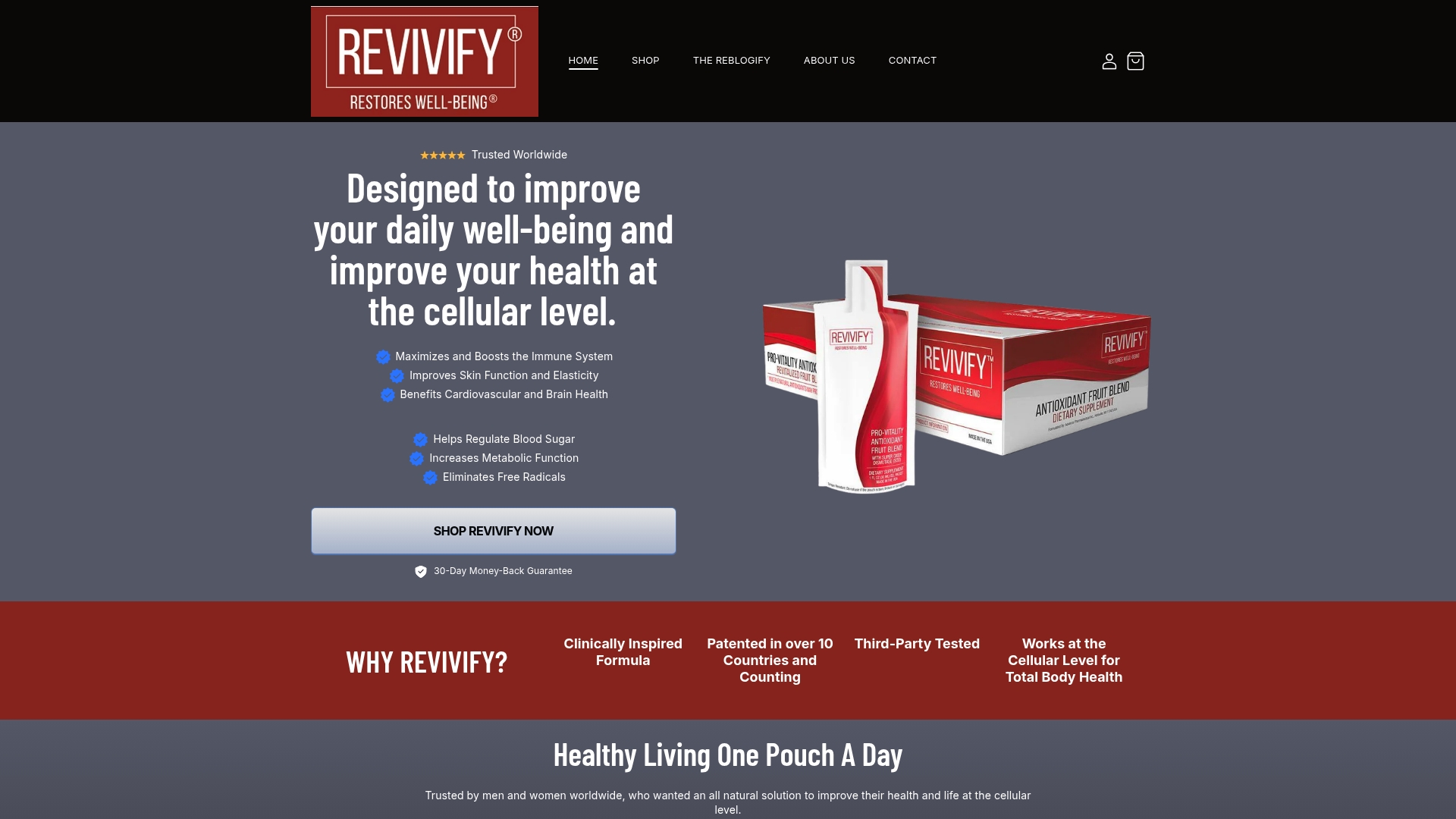
This isn’t a replacement for a well-formulated topical routine, and it won’t reverse sun damage overnight. What it does is give your body ongoing systemic support for oxidative stress, inflammation, and cellular well-being, areas that a serum applied to your cheeks simply can’t reach. If daily, whole-body antioxidant support sounds like the missing piece in your routine, you can check out the supplement and see whether the subscription option fits how you already think about your health.
This article is general information, not a substitute for advice from a qualified doctor. Consult a qualified healthcare professional about your own circumstances before acting on anything here.
Sources
- PubMed: Study reporting SOD-containing cream effects on atopic dermatitis (2017)
- The Applications and Mechanisms of Superoxide Dismutase in Medicine, Food, and Cosmetics (2023)
- SpecialChem: Superoxide dismutase ingredient profile