

Types of Gut Microbiome Imbalances and What to Do About Each
Gut microbiome imbalance, or dysbiosis, breaks down into three primary functional types: a loss of beneficial commensal bacteria, an overgrowth of harmful pathobionts, or a reduction in overall microbial diversity. Most people who deal with dysbiosis show some combination of the three, not a single clean category.
If you take away one action item, make it this: increase the diversity of non-digestible plant fibers you eat, since that single habit supports commensal recovery, starves out opportunistic species, and rebuilds diversity all at once. A clinical primer on dysbiosis ties reduced commensals and rising Proteobacteria directly to inflammation, which is worth knowing before you chase a lab test.
- Type 1: loss of beneficial commensals (think butyrate producers, gone missing)
- Type 2: overgrowth of pathobionts (opportunists like Proteobacteria taking territory)
- Type 3: reduced overall diversity (a thinner, less resilient ecosystem overall)
One number worth remembering: Proteobacteria typically make up less than 10% of a healthy gut community, but in dysbiosis that share can climb toward 20 to 30%, a shift linked to measurable inflammation. Stool panels can hint at this. They can’t diagnose it with certainty, and that gap matters more than most marketing admits.
Key Takeaways
Gut microbiome imbalance splits into three functional types, loss of commensals, pathobiont overgrowth, and reduced diversity, and correcting it starts with dietary fiber diversity, not a lab test or a pill.
| Point | Details |
|---|---|
| Three functional types | Dysbiosis means losing beneficial commensals, pathobionts overgrowing, or overall diversity dropping, often together. |
| Proteobacteria signature | Levels can rise from under 10% to roughly 20 to 30% of the gut community during dysbiosis. |
| Symptoms go beyond digestion | Bloating and diarrhea often pair with fatigue, mood shifts, and metabolic changes tied to reduced SCFA output. |
| Testing has real limits | Stool panels and SIBO breath tests help but lack a universal healthy baseline for comparison. |
| Lifestyle changes come first | Fiber diversity, sleep, stress reduction, and movement outperform supplements as the starting point for recovery. |
Table of Contents
- The Three Types of Gut Microbiome Imbalances Explained
- What Gut Health Issues and Systemic Symptoms Look Like
- What Causes Dysbiosis and Who’s at Higher Risk
- How Dysbiosis Gets Diagnosed and Where Testing Falls Short
- How to Restore Microbiome Balance: A Practical Framework
- When to See a Clinician About Gut Symptoms
- Try Tryrevivify for Daily Gut and Cellular Support
- Frequently Asked Questions
- Sources
The Three Types of Gut Microbiome Imbalances Explained
Each functional type has its own signature, its own typical trigger, and its own downstream risk. Knowing which one (or which combination) fits your situation helps you and your clinician target the right fix instead of guessing.
Loss of beneficial commensals happens when species that perform specific jobs disappear or drop to low numbers. The clearest example is butyrate producers like Faecalibacterium prausnitzii, a bacterium that feeds colon cells and helps maintain colonization resistance against invaders. Lose enough of these workers and the gut lining gets less fuel, immune signaling shifts, and the door opens for opportunists to move in. Broad-spectrum antibiotics are the most common trigger, but a chronically low-fiber diet produces a slower version of the same effect.
Overgrowth of pathobionts is what happens when normally low-abundance, potentially troublesome bacteria expand past their usual limits. Proteobacteria, a phylum that includes many Enterobacteriaceae, is the best-documented example, and in some cases the concern is more specific: Clostridioides difficile overgrowth after antibiotic courses wipe out competing species. This type tends to show up fast, often within days of a triggering event, and it correlates with acute symptoms rather than the slow drift you see with commensal loss.

Reduced overall diversity describes an ecosystem that has simply gotten smaller and less varied, regardless of which specific species are up or down. A diverse microbiome behaves like a diversified investment portfolio: more species means more redundancy, so if one function drops out, another organism can often cover for it. Low diversity strips out that redundancy, and a 2024 review in Frontiers in Nutrition connects this instability to elevated risk across several chronic conditions, not just digestive ones.
Pro Tip: Don’t assume you fit neatly into one category. Clinical patterns show these three types overlap constantly, meaning someone recovering from a C. difficile infection often has low diversity and depleted commensals at the same time.
What Gut Health Issues and Systemic Symptoms Look Like
Digestive symptoms are usually the first clue something’s off. Bloating, abdominal distension, abdominal pain, and diarrhea show up frequently in the clinical literature on dysbiosis, and a scoping review on dysbiosis lists these as the most consistently reported presentations. Constipation, or bowel habits that swing between the two extremes, rounds out the common picture.
- Bloating and abdominal distension
- Cramping or diffuse abdominal pain
- Diarrhea, constipation, or alternating patterns
- Fatigue that doesn’t track with sleep hours
- Mood changes, including anxiety or low mood
- Metabolic shifts, like unexpected blood sugar swings
- More frequent minor infections
The nonspecific systemic symptoms are where things get less obvious. Fatigue, mood changes, and metabolic disruption don’t scream “gut problem” the way diarrhea does, but they often travel together with it. Consumer health reporting has flagged sleep and mood shifts as common companions to dysbiosis, while cautioning that a lot of this evidence is correlational rather than proven cause and effect.
The mechanism runs through short-chain fatty acids. When commensal loss or low diversity cuts SCFA production, the gut’s mucus barrier weakens, inflammation rises, and low levels of bacterial byproducts can slip into circulation, a process that helps explain why a gut problem can feel like a whole-body problem.
What Causes Dysbiosis and Who’s at Higher Risk
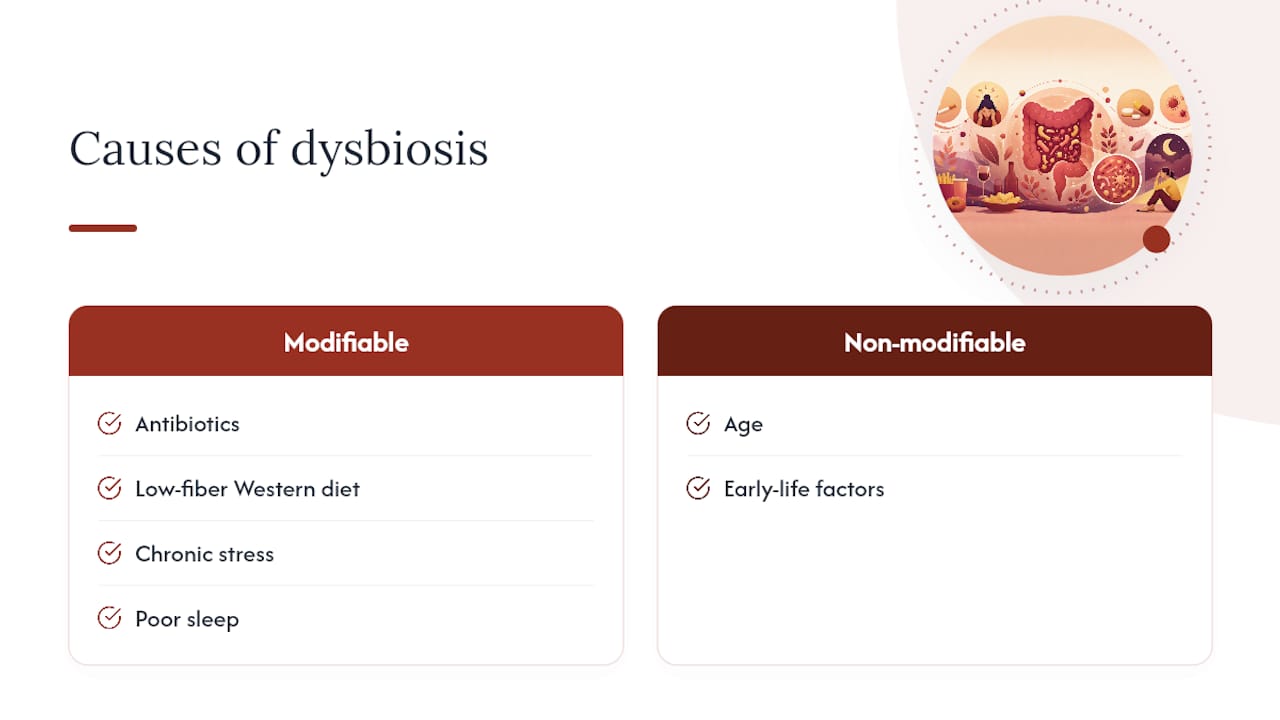
Some causes of dysbiosis you can change starting this week. Others you’re stuck with, and the smart move is knowing which is which.
Modifiable factors:
- Antibiotic courses, especially broad-spectrum or repeated ones
- A low-fiber, ultra-processed Western diet
- Chronic stress
- Poor or insufficient sleep
- Sedentary habits
- Long-term proton pump inhibitor use
Nonmodifiable factors:
- Age (diversity tends to narrow later in life)
- Early-life exposures, including birth mode and infant feeding
- Genetic predisposition
Different drivers tend to push toward different types. Antibiotics are the classic trigger for both commensal loss and reduced diversity at once, while repeated antibiotic exposure combined with hospitalization raises C. difficile risk specifically, an overgrowth pattern the clinical primer on dysbiosis calls out directly.
Pro Tip: Trying to fix diet, sleep, and stress one at a time rarely works because they reinforce each other. Poor sleep raises cortisol, which drives cravings for the very ultra-processed foods that starve your commensals. Address all three together for results you’ll actually notice.
How Dysbiosis Gets Diagnosed and Where Testing Falls Short
Evaluation typically starts with history and a physical exam, then moves to targeted testing if symptoms persist. Stool-based microbiome panels, pathogen-specific PCR testing, breath testing for small intestinal bacterial overgrowth (SIBO), and targeted cultures for C. difficile are the main tools clinicians reach for, alongside blood work when systemic inflammation is suspected.
- History and physical exam
- Stool microbiome panels or pathogen PCR
- Breath testing for SIBO
- Targeted culture for C. difficile
- Blood markers for inflammation, when indicated
The limits matter as much as the tools. There is no single agreed-upon “healthy” microbiome baseline to measure against, results vary between labs, and a normal diet change can shift your microbial profile within days. Cleveland Clinic’s overview of dysbiosis notes that stool and breath testing have real diagnostic value but limited ability to guide treatment on their own.
Commercial microbiome panels are best treated as a data point, not a diagnosis. Targeted testing earns its keep in specific situations, like persistent diarrhea or a recent severe antibiotic course, but running a broad panel without a clear clinical question rarely changes what you’d do anyway.
How to Restore Microbiome Balance: A Practical Framework
Lifestyle changes come first, and the evidence behind them is stronger than most supplement marketing suggests. Harvard Health’s guidance on gut health treats probiotics and prebiotics as adjuncts to foundational habits, not replacements for them.
- Diversify plant fiber intake and cut ultra-processed foods. This is the single highest-leverage step. Fiber feeds the mucus barrier that keeps pathobionts in check, though results build over weeks, not days.
- Prioritize sleep and stress reduction. Sleep debt and chronic stress both alter gut motility and immune signaling; fixing sleep often improves digestive symptoms before diet changes fully kick in.
- Move your body regularly. Physical activity is linked to greater microbial diversity independent of diet, even at moderate intensity.
- Review medications with a clinician. Unnecessary antibiotics or long-term PPI use should get a second look, since both are common, correctable drivers of commensal loss.
- Add targeted adjuncts under guidance. Specific probiotic strains help with antibiotic-associated diarrhea and certain IBS presentations, and Saccharomyces boulardii has evidence specifically for antibiotic-associated diarrhea. Prebiotic supplements can support this step, but strain and indication matter more than the word “probiotic” on a label.
- Benefit: durable diversity gains. Evidence: dietary fiber trials. Watch for: results take consistency, not a single “detox” week.
- Benefit: symptom relief in specific cases. Evidence: strain-specific probiotic trials. Watch for: the wrong strain for your issue does little.
Fecal microbiota transplant (FMT) has strong evidence only for recurrent C. difficile infection and should not be considered for general dysbiosis outside a clinical setting. Antibiotics carry the same caution in reverse: they can resolve an active pathobiont overgrowth but risk deepening commensal loss, so they belong under a clinician’s direction, not self-directed use.
Microbial populations can shift within 24 hours of a dietary change, but most of those shifts are transient. The durable improvements come from sustained habits over months, not a single clean week of eating well.
Track your progress with this checklist: note weekly symptom frequency, fiber source variety (aim for a wide range of plant types, not just volume), sleep hours, and any medication changes, then reassess at four and twelve weeks.
When to See a Clinician About Gut Symptoms
Most dysbiosis symptoms respond to lifestyle changes within weeks. Some signs need faster attention.
See a clinician promptly if you notice:
- Unexplained or severe weight loss
- Persistent high fever
- Blood in stool
- Severe diarrhea with signs of dehydration
- Symptoms suggesting a systemic infection
- Progressive neurologic symptoms
Bring this to your appointment:
- Recent antibiotic use and when
- Duration and pattern of symptoms
- Any prior stool or breath test results
- Current medications, especially PPIs or immunosuppressants
- Your specific goal: symptom relief or a formal diagnosis
Expert Consensus on Gut Microbiota Types and Resilience
A resilient microbiome shows high diversity and a strong presence of obligate anaerobic commensals, while dysbiosis tends to be highly individual rather than following one template. This is often called the Anna Karenina principle: healthy guts resemble each other, but each unhealthy gut is disrupted in its own way.
Systemic effects of gut imbalance often show up in places patients don’t expect, from energy levels to mood, long before a lab value looks abnormal.
Author byline: written with editorial contribution from Larry for Tryrevivify.
Our Take on Managing Gut Microbiome Imbalances
We built Tryrevivify around the same lifestyle-first logic this article lays out: feed the commensals with prebiotic fiber, support the antioxidant defenses that keep inflammation from taking hold, and treat any supplement as an adjunct to real habits, not a replacement for them. If your symptoms are mild, start with diet, sleep, and movement. If anything on the red-flag list above applies to you, talk to a clinician before trying anything else.
Try Tryrevivify for Daily Gut and Cellular Support
None of the five management steps above require a supplement to work, but consistency is easier with the right support in your routine. Tryrevivify combines superoxide dismutase, prebiotic fiber, polyphenols, and lactobacillus in a single daily gel, designed to support the same fiber-and-microbiome foundation this article recommends, while also addressing the oxidative stress that so often rides alongside dysbiosis. The formula is third-party tested and plant-based, and it comes with a risk-free guarantee plus subscription savings for people who want to build this into a long-term habit rather than a one-off try. If you’re already working on fiber diversity, sleep, and stress, Tryrevivify’s daily supplement is built to reinforce that same foundation at the cellular level.
Frequently Asked Questions
What are the three main types of gut microbiome imbalances? The three primary functional types are loss of beneficial commensal bacteria, overgrowth of harmful pathobionts, and reduced overall microbial diversity. Many people show a combination rather than a single isolated type.
What are the most common microbiome imbalance symptoms? Bloating, abdominal pain, distension, and diarrhea are the most frequently reported gut symptoms, while fatigue, mood changes, and metabolic shifts often appear as nonspecific systemic effects.
What causes dysbiosis? Antibiotics, a low-fiber Western diet, chronic stress, poor sleep, and long-term PPI use are the leading modifiable causes, while age and early-life factors contribute risk you can’t fully control.
Can gut microbiome imbalance be reversed? Many people improve meaningfully with sustained fiber diversity, better sleep, and stress reduction, though durable change tends to take months rather than days, and some causes need medical treatment.
Are at-home microbiome tests worth it? They can offer interesting data, but they lack a standardized healthy baseline and vary between labs, so treat results as a talking point for your clinician rather than a diagnosis.
This article is general information, not a substitute for advice from a qualified doctor. Consult a qualified healthcare professional about your own circumstances before acting on anything here.
Sources
- Gut microbiome health and dysbiosis: A clinical primer - PMC
- PubMed article noting Proteobacteria expansion in dysbiosis
- Approach to the diagnosis and management of dysbiosis — Frontiers in Nutrition