

What Is the Microbiome Gut-Brain Axis? A Full Breakdown
The microbiome gut-brain axis is the bidirectional communication network linking trillions of gut microbes to your central nervous system through neural, hormonal, and immune signals. Your gut bacteria produce compounds that reach the brain, and your brain sends signals right back down to your gut, which is why stress can trigger stomach pain and why gut inflammation can show up as brain fog or a low mood.
The evidence for this system is uneven in a way that matters for how you interpret headlines. Animal research on the gut-brain connection is extensive and mechanistically detailed. Human data is growing fast but still catching up.
The axis runs on four main channels:
- Neural signaling through the vagus nerve and the enteric nervous system
- Endocrine signaling via hormones like cortisol and gut-derived peptides
- Immune signaling through cytokines and inflammatory messengers
- Microbial metabolites, including short-chain fatty acids and tryptophan derivatives, that interact directly with nerve and immune cells
Key Takeaways
The gut-brain axis works because microbial metabolites, immune signals, and vagal nerve activity constantly exchange information between your digestive tract and your central nervous system.
| Point | Details |
|---|---|
| It’s bidirectional | Signals travel from gut to brain and brain to gut through neural, endocrine, and immune routes. |
| SCFAs matter most | Short-chain fatty acids from fiber fermentation support gut barrier integrity and immune regulation. |
| Human evidence lags animal data | Germ-free mouse studies are far more established than human intervention trials. |
| Fiber beats single supplements | Feeding existing gut bacteria with diverse prebiotic fiber often outperforms importing one probiotic strain. |
| Tryrevivify supports, doesn’t treat | Its prebiotic fiber and antioxidant formula is an adjunct to diet and stress management, not medical care. |
Table of Contents
- How Does the Gut Communicate With the Brain?
- What Gut Microbes Actually Produce That Affects Your Brain
- What Does the Research Actually Prove?
- Which Conditions Are Linked to Gut-Brain Axis Dysfunction?
- How Can You Support a Healthy Gut-Brain Connection?
- How Does the Gut-Brain Axis Change From Infancy to Old Age
- Do Antibiotics Permanently Disrupt the Gut-Brain Axis?
- Can Your Genes Shape Your Gut-Brain Axis?
- How Do Scientists Actually Study the Gut-Brain Axis?
- What Treatments Are Being Investigated for the Gut-Brain Axis?
- Frequently Asked Questions
- Sources
How Does the Gut Communicate With the Brain?
Your gut has its own nervous system, and it’s bigger than most people realize. The enteric nervous system, sometimes called the “second brain,” lines your digestive tract and can operate somewhat independently of the brain in your skull. According to Harvard Health, it contains a very large number of nerve cells, more than you’ll find in your spinal cord.
Fast fact: The enteric nervous system’s 100 million-plus neurons make it the largest concentration of nerve tissue outside the brain and spinal cord, which is why researchers describe gut-brain signaling as a genuine two-way conversation rather than the brain simply issuing orders downstream.
The vagus nerve is the primary hardwired connection between the two systems. It runs from the brainstem down through the neck and chest into the abdomen, carrying signals in both directions, though the majority of its fibers actually carry information from the gut up to the brain rather than the other way around. This is one reason gut distress registers so quickly as anxiety or unease, and why calming the gut physically (through slow breathing or vagal stimulation techniques) can measurably shift mood.
Three other systems reinforce the vagus nerve’s work:
- Endocrine signaling. Stress hormones like cortisol alter gut motility and permeability, while gut cells release hormones such as ghrelin and peptide YY that travel through the bloodstream to influence appetite and mood centers in the brain.
- Immune signaling. Immune cells in the gut lining detect microbial activity and release cytokines that can cross into brain tissue, acting as chemical messengers of inflammation. Researchers such as Jun Huh have described these immune cells as carriers of distress signals from gut inflammation to the brain.
- Barrier regulation. The intestinal lining and the blood-brain barrier both act as selective gatekeepers, normally blocking harmful bacteria and toxins while letting signaling molecules through. When either barrier becomes more permeable than it should be, a state some researchers call increased permeability, the exchange of information (and potentially harmful compounds) becomes less controlled.
What Gut Microbes Actually Produce That Affects Your Brain
The bacteria in your gut aren’t passive passengers. They’re chemical factories, and what they produce depends heavily on what you feed them.

Short-chain fatty acids (SCFAs) are the best-studied output. When gut bacteria ferment dietary fiber, they generate SCFAs like butyrate, propionate, and acetate. These compounds nourish the cells lining your colon, help regulate inflammation, and appear to influence brain function indirectly by strengthening the gut barrier and modulating immune activity. The Brain-Gut-Microbiome Axis review identifies SCFAs, bile acids, and tryptophan metabolites as the primary chemical mediators connecting microbial activity to nervous system function.
Statistic callout: Much of the body’s serotonin, a neurotransmitter closely tied to mood regulation, is manufactured in the gut rather than the brain, largely through pathways that depend on tryptophan metabolism carried out with input from gut bacteria.
Tryptophan is an amino acid you get from food, and it’s the raw material for serotonin production. Gut microbes influence how much tryptophan is available for this pathway versus other metabolic routes, which is part of why gut health and mood tracking have become so intertwined in recent research.
Beyond SCFAs and tryptophan pathways, certain gut bacteria produce molecules that resemble neurotransmitters:
- Some Lactobacillus and Bifidobacterium strains can generate GABA-like compounds, the same inhibitory neurotransmitter your brain uses to calm neural activity.
- Certain strains produce dopamine-like or norepinephrine-like molecules.
- These microbial neurotransmitter homologues are measured mostly in lab and animal studies right now. Whether they cross into circulation in meaningful amounts in humans, or simply act locally within the gut, remains an open question.
The messengers between microbes and nerves are specialized gut cells called enteroendocrine cells, some of which form direct synaptic-like connections with vagal nerve endings. Recent work in Nature Reviews Microbiology describes these cells, sometimes called neuropods, as a critical relay point where microbial signals get converted into electrical signals the nervous system can actually use.
What Does the Research Actually Prove?
Here’s where a lot of popular coverage overreaches. The strongest evidence for the gut-brain axis comes from germ-free mice, animals raised with no gut bacteria at all, and from fecal transplant experiments where microbes from one animal (or a human donor) are transferred into another. These paradigms have produced striking results: germ-free mice show altered stress responses and social behavior, and transplanting microbiota from anxious donor mice into germ-free recipients can transfer anxiety-like behaviors.
Human evidence tells a messier story. Observational studies link certain microbial patterns to depression, anxiety, and irritable bowel syndrome, but these studies can’t establish which came first, the gut change or the mood change. Intervention trials testing probiotics or dietary changes on mood outcomes show inconsistent results across studies.
Common limitations show up again and again:
- Small sample sizes that limit statistical power
- Confounding factors like diet, medication use, and stress that are hard to fully control
- Strain-specific effects, meaning a finding for one probiotic strain often doesn’t generalize to others
- Short study durations that can’t capture longer-term microbial shifts
A recent Science analysis puts it plainly: microbial metabolites identified in animal models are promising therapeutic targets, but translational human evidence remains incomplete.
Pro Tip: When you see a headline claiming a probiotic “cures” anxiety or depression, check whether the underlying study was done in mice or humans, and if humans, how many participants were involved. A 12-mouse study and a 200-person clinical trial are not the same kind of evidence, even when the headline treats them identically.
Which Conditions Are Linked to Gut-Brain Axis Dysfunction?
Gut-brain axis dysregulation shows up first as physical gut symptoms: bloating, abdominal pain, and altered bowel habits, the hallmark trio of irritable bowel syndrome. Harvard Health notes that psychological stress genuinely alters gut physiology, including motility and pain sensitivity, which is why functional GI disorders and mood disturbances so often travel together.
Beyond the gut itself, researchers have documented associations with:
- Anxiety and depression, where gut inflammation markers sometimes correlate with symptom severity
- Autism spectrum signals, an area of active investigation rather than settled science
- Parkinson’s disease, where some researchers suspect gut pathology may precede motor symptoms by years
- Emerging cognitive effects tied to long COVID, an association that Stanford Medicine has flagged as a developing area of study
For functional GI disorders specifically, clinicians commonly use cognitive behavioral therapy, gut-directed hypnotherapy, and dietary strategies like the low-FODMAP approach, often in combination rather than alone, according to guidance from Johns Hopkins Medicine.
None of these associations prove causation. A gut-brain link showing up in a study means the two systems correlate, not that fixing one guarantees fixing the other. Persistent GI symptoms, unexplained mood changes, or new neurological symptoms all warrant a conversation with a physician rather than a supplement aisle.
How Can You Support a Healthy Gut-Brain Connection?
The single highest-leverage lever most people are missing isn’t a specific supplement. It’s dietary fiber diversity, and it’s not close.
- Feed your microbes first. Prebiotic fiber, the kind found in onions, garlic, oats, and legumes, fuels SCFA-producing bacteria directly. Practitioners increasingly emphasize this “feed the microbes” approach over chasing a single probiotic strain, since a well-fed microbial community tends to outperform a single imported one. Our guide on improving your gut microbiome with prebiotics breaks down specific food sources.
- Add fermented foods deliberately. Yogurt, kefir, sauerkraut, and kimchi introduce live cultures, though the mood and cognitive benefits of probiotic supplements remain condition-dependent and strain-specific rather than universal.
- Treat stress reduction as a gut intervention, not just a mental health one. Cognitive behavioral therapy and medical hypnotherapy have measurable effects on gut symptoms, not only on anxiety. Slower, structured breathing and gentle movement practices, like the gut-focused yoga sequences some practitioners recommend for constipation relief, stimulate the vagus nerve directly.
- Prioritize sleep and regular movement. Both influence microbial diversity and gut motility in ways that compound over weeks, not days.
Pro Tip: Start with one change, not five. Add one high-fiber food daily for two weeks and track digestion and mood loosely before layering on fermented foods or supplements. Microbial shifts take time, and stacking variables makes it impossible to know what actually helped.
If you’re immunocompromised, pregnant, or managing a chronic illness, talk with a clinician before adding fermented foods or probiotic supplements in any meaningful quantity. The connection between food choices and mood is real, but it works gradually, through consistent patterns, not a single meal or supplement dose.
Where Prebiotic-Focused Supplements Fit In
Tryrevivify’s approach centers on prebiotic fiber paired with antioxidant support, because feeding the bacteria you already have tends to matter more than importing new strains. Here’s what that means practically:
- Prebiotic fiber gives SCFA-producing bacteria the raw material they need to function
- Antioxidant support (via superoxide dismutase) addresses oxidative stress, a separate but related contributor to systemic inflammation
- For deeper dietary context, see our breakdown of how the gut microbiome affects digestion
- A supplement like this is adjunctive. It supports an existing routine of fiber, sleep, and stress management; it doesn’t replace medical care for diagnosed conditions
How Does the Gut-Brain Axis Change From Infancy to Old Age
Your gut microbiome isn’t static, and neither is its relationship with your brain. Infants are born with a limited microbial population that expands rapidly during the first two to three years of life, a window researchers consider critical for both immune training and early neurodevelopment. Delivery mode, breastfeeding, and early antibiotic exposure all shape which bacterial species take hold during this period.
Adolescence brings a second wave of change, coinciding with puberty-related hormonal shifts that influence both gut composition and stress reactivity. This overlap may help explain why anxiety and gut symptoms so often emerge together during the teenage years.
Adult microbiomes are relatively stable when diet, sleep, and stress stay consistent, but that stability can mask slow drift. Years of processed food, chronic stress, or repeated antibiotic courses gradually shift the microbial balance in ways that often go unnoticed until a symptom appears.
Aging introduces its own pattern: microbial diversity tends to decline, and populations of beneficial SCFA-producing bacteria often shrink. This decline has been proposed as a contributing factor in the increased inflammation seen with age, sometimes called inflammaging, and researchers are actively studying whether it plays a role in age-related cognitive changes. None of this is fixed. Diet and lifestyle changes at any age can still shift the microbial balance, though the effect size and speed of change tend to be greatest earlier in life.
Do Antibiotics Permanently Disrupt the Gut-Brain Axis?
Antibiotics save lives, and they also reshape the gut microbiome, sometimes dramatically. A single course can reduce microbial diversity within days, wiping out both harmful and beneficial species indiscriminately. Most healthy adults see their gut community recover substantially within weeks to a few months, though certain bacterial species can remain diminished or absent for far longer, and repeated courses compound the disruption.
The gut-brain relevance here isn’t hypothetical. Reduced microbial diversity means fewer SCFA-producing bacteria, which means less of the fuel that supports gut barrier integrity and the signaling pathways described earlier in this article. Some patients report temporary digestive and mood changes following antibiotic treatment, though isolating antibiotics as the sole cause is difficult given how often illness, stress, and medication overlap in real life.
Antibiotics aren’t the only medications with this footprint. Proton pump inhibitors, commonly used for acid reflux, alter the gut’s pH environment enough to shift bacterial populations. Nonsteroidal anti-inflammatory drugs can affect gut barrier integrity with regular use. Even some psychiatric medications appear to influence microbial composition, an emerging research area that complicates the simple story of gut bacteria driving mood, since mood medications may also be reshaping the gut that supposedly influences mood.
None of this means avoiding necessary medication. It does mean that supporting microbial recovery with fiber and fermented foods after a prescribed antibiotic course is a reasonable, low-risk habit, not a fringe idea.
Can Your Genes Shape Your Gut-Brain Axis?
Genetics load the dice for your microbiome, but they don’t determine the outcome outright. Twin studies suggest certain bacterial taxa are more heritable than others, meaning genetics influences which microbial species are more likely to establish themselves, while diet and environment still do most of the work in determining overall community composition.
Specific genetic variants matter in more targeted ways. Variations in genes governing immune signaling can influence how aggressively your body responds to microbial signals, which partly explains why two people eating identical diets can have different levels of gut inflammation. Genes involved in mucus production and gut barrier structure also vary between individuals, affecting how permeable that barrier naturally tends to be.
Epigenetics adds another layer entirely. Unlike fixed DNA sequences, epigenetic markers, chemical tags that turn genes on or off, can be directly influenced by microbial metabolites. SCFAs, for instance, are known to affect histone modification, a mechanism that changes how tightly DNA is packaged and therefore how accessible certain genes are for expression. This means your gut bacteria may be quietly influencing which of your own genes get switched on, particularly genes tied to immune regulation and inflammation control.
The practical takeaway isn’t that your genetic makeup locks you into a particular gut-brain outcome. It’s that genetics sets a baseline of susceptibility, while diet, stress, and microbial exposure determine how much of that susceptibility actually gets expressed.
How Do Scientists Actually Study the Gut-Brain Axis?
The tools for studying this system have improved considerably, and the improvements explain why human evidence is finally catching up to the animal data.
Metagenomic sequencing allows researchers to identify every bacterial species present in a stool sample, along with their relative abundance, without needing to culture each one individually in a lab. This technique replaced older culture-based methods that missed the majority of gut species, since most gut bacteria don’t grow well outside the body.
Metabolomics goes a step further, measuring the actual chemical byproducts (SCFAs, tryptophan derivatives, bile acids) that microbes produce, rather than just cataloging which species are present. This matters because two people can have different bacterial populations that produce nearly identical metabolic outputs, or the reverse.
Neuroimaging techniques, particularly functional MRI, let researchers observe brain activity changes in response to gut interventions in real time. Some studies have used fMRI to track how probiotic supplementation or dietary fiber changes correlate with activity in brain regions tied to emotional processing.
Germ-free animal models remain the gold standard for establishing mechanism, since researchers can introduce specific bacterial strains into a completely sterile gut and observe the resulting changes in isolation, something impossible to do ethically in humans.
Combining these approaches, genomic data with metabolic data with brain imaging, is where the field is heading, and it’s producing far more nuanced pictures than any single method could offer alone.
What Treatments Are Being Investigated for the Gut-Brain Axis?
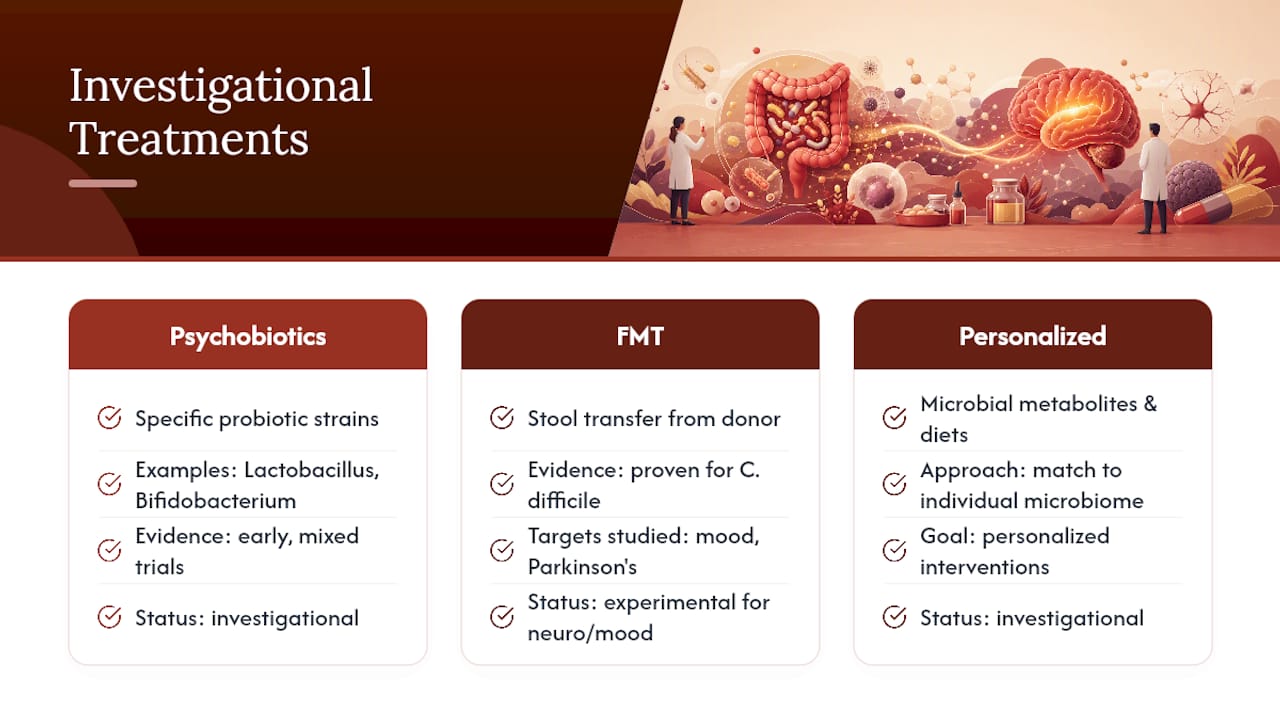
Two approaches dominate current research interest, and both remain investigational rather than established standard care.
Psychobiotics refers to probiotic strains specifically studied for potential mental health effects, as opposed to general digestive support. Early trials have tested specific Lactobacillus and Bifidobacterium strains for mild mood and stress-related outcomes, with mixed results that vary by strain, dose, and study population. The field is young enough that no single strain has emerged as a reliable, universally effective option.
Fecal microbiota transplantation (FMT) involves transferring stool from a screened donor into a recipient’s gut, most commonly used today as an established treatment for recurrent Clostridioides difficile infection. Researchers are now investigating whether FMT could help conditions with a proposed gut-brain component, including certain mood disorders and Parkinson’s disease, though these applications remain experimental and are not approved standard treatments outside of infection control.
Other approaches under investigation include targeted delivery of specific microbial metabolites (rather than whole bacterial strains) and precision diets designed around an individual’s existing microbial profile. Both represent a shift toward personalization, matching the specific intervention to the specific gut community, rather than a one-size-fits-all product.
None of these therapies have reached the point where a clinician would recommend them as a primary treatment for a mood or neurological condition. They represent genuinely promising research directions, not near-term prescriptions.
A Personal Note on Applying This Science
What strikes me most about this research is how ordinary the effective interventions actually are. Fiber, sleep, and stress management outperform most supplements in the data we have. If you’re dealing with persistent symptoms, see a clinician before chasing the next miracle claim online.
A Supportive Option, Not a Substitute for Care
If you’re looking to support your gut-brain axis with a daily habit rather than a five-step protocol, Tryrevivify combines prebiotic fiber with superoxide dismutase, an antioxidant enzyme, and polyphenols in a single daily gel, built around feeding the bacteria you already have rather than importing a single new strain. It’s designed as a supportive, non-therapeutic addition to a routine already built on fiber, sleep, and stress management, not a replacement for either. For diagnosed digestive or neurological conditions, talk with a clinician first. If you want to see how the formula fits into a daily routine, visit the Tryrevivify product page and check current subscription options.
Frequently Asked Questions
What is the microbiome gut-brain axis in simple terms? It’s the two-way communication system between your gut bacteria and your brain, carried out through nerve signals (mainly the vagus nerve), hormones, and immune messengers. Gut microbes produce compounds that can influence mood and brain function, while stress and brain activity can alter gut function in return.
Can an unhealthy gut microbiome cause anxiety or depression? Research shows a real association between gut microbial patterns and mood disorders, but human studies can’t yet prove the gut microbiome directly causes anxiety or depression in most cases. Stress and mood also change gut function, making the relationship genuinely bidirectional rather than one-directional.
Do probiotics actually improve brain function? Some specific strains, studied as psychobiotics, show modest effects on stress and mood markers in certain trials, but results are strain-specific and inconsistent across studies. Prebiotic fiber that feeds your existing gut bacteria has more consistent supporting evidence than most standalone probiotic products.
How long does it take to change your gut microbiome? Meaningful shifts in bacterial composition can begin within days of a dietary change, but stable, lasting changes typically take several weeks of consistent habits. Diversity built through fiber and fermented foods tends to be more durable than shifts from short-term interventions.
Is the gut-brain axis linked to Parkinson’s disease? Emerging research, including work highlighted by Stanford Medicine, suggests gut changes may precede Parkinson’s motor symptoms in some patients, but this remains an active area of investigation rather than a settled causal link.
Sources
- How the gut-brain connection influences mood - Harvard Health
- The Brain–Gut–Microbiome Axis — review (PMC)
- Modulating brain function with microbiota (Science)
- The gut-brain connection: What the science says - Stanford Medicine