

Why Gut Health Affects Nutrient Absorption
Gut health is the primary determinant of how well your body extracts and uses the nutrients in every meal you eat. The scientific term for this process is nutrient bioavailability, and it depends on three interconnected systems: your gut microbiome, the structural integrity of your intestinal lining, and the enzymes and transport proteins that move nutrients into your bloodstream. When any one of these systems is compromised, even a nutrient-dense diet fails to deliver its full benefit. Understanding why gut health affects nutrient absorption gives you the clearest possible lens for evaluating your overall wellness strategy.
Why gut health affects nutrient absorption at the cellular level
The gut microbiome is a community of trillions of bacteria, fungi, and other microorganisms living primarily in your large intestine. These microbes are not passive passengers. They actively break down food compounds your own digestive enzymes cannot process, and in doing so, they determine how much of what you eat actually reaches your cells.
A healthy gut microbiome enhances absorption of carbohydrates, proteins, fats, vitamins, and minerals by breaking down compounds efficiently and protecting against inflammation. This means the microbiome functions less like a side actor and more like a co-processor in your digestive system.
The intestinal lining is equally critical. It is lined with finger-like projections called villi, and each villus is covered in even smaller microvilli. Together, these structures create a surface area roughly the size of a tennis court, all dedicated to absorbing nutrients. When that lining is healthy, nutrients pass through efficiently. When it is damaged or inflamed, absorption drops sharply regardless of what you eat.

Enzymes produced by the pancreas, stomach, and small intestine break food into absorbable units: proteins into amino acids, fats into fatty acids, carbohydrates into simple sugars. Without adequate enzyme activity, food passes through partially digested, and the nutrients it contains are lost.
How the gut microbiome supports nutrient breakdown
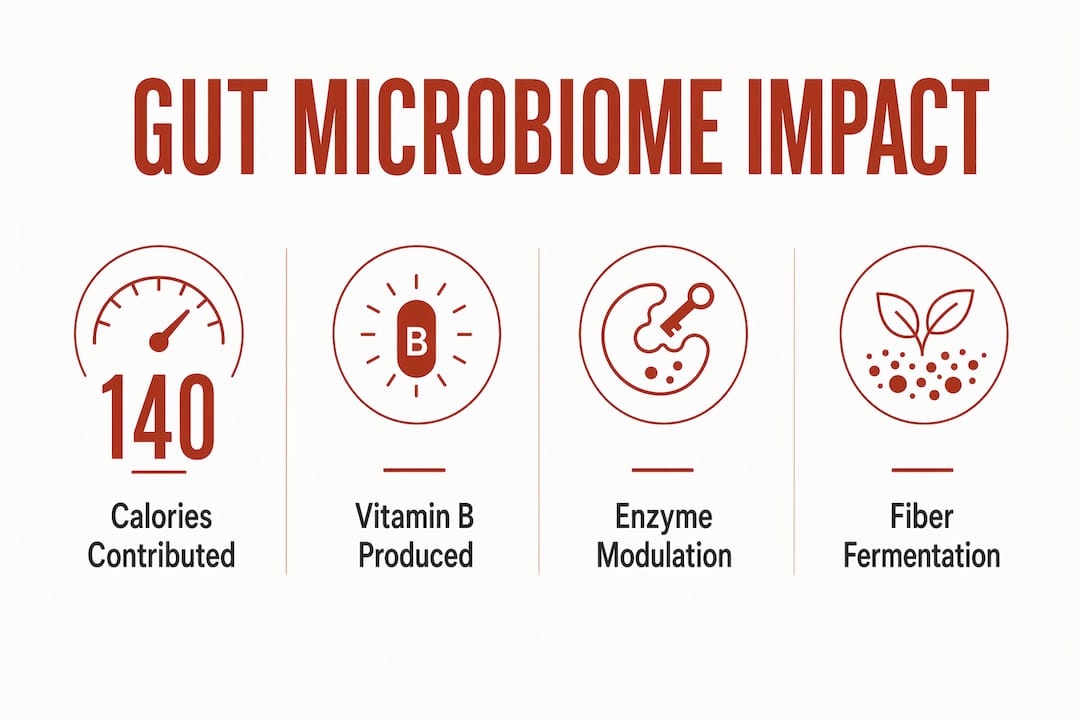
Microbial fermentation in the colon is one of the most underappreciated contributors to your daily energy supply. Gut microbes produce roughly 140 calories per day through fermentation, accounting for approximately 7.4% of your total usable energy. That figure represents a meaningful metabolic contribution that traditional nutrition models have historically ignored.
Here is what your gut microbiome specifically does to support nutrient uptake:
- Ferments dietary fiber into short-chain fatty acids (SCFAs) like butyrate, propionate, and acetate, which fuel colon cells and reduce gut inflammation
- Synthesizes vitamins including B12, vitamin K, folate, and biotin, which are absorbed directly through the gut lining
- Enhances mineral absorption of calcium, magnesium, and iron by lowering intestinal pH through fermentation byproducts
- Regulates nutrient transporters such as P-glycoprotein (P-gp) and BCRP, which control how nutrients and compounds move across the intestinal wall
The gut microbiota modulates these intestinal transport proteins through molecular signaling, which means microbial imbalance does not just affect digestion. It directly alters the biological machinery responsible for moving nutrients into your bloodstream.
There is also a counterintuitive finding worth noting. High-fiber diets promote more microbial fermentation and produce more SCFAs, but they also result in fewer net absorbed calories compared to low-fiber Western diets. This is not a reason to avoid fiber. It means fiber-rich eating supports gut health and metabolic efficiency even while moderating caloric extraction, which is exactly the outcome most people want.
Pro Tip: Adding prebiotic-rich foods like chicory root, garlic, and green bananas to your diet feeds the bacterial strains most responsible for SCFA production. Learn more about improving your microbiome with targeted prebiotic strategies.
What happens when gut health is compromised
Gut dysfunction reduces nutrient absorption through four distinct mechanisms, and they often occur together.
-
Villi damage from inflammation. Conditions like Crohn’s disease and Ulcerative Colitis cause inflammation that damages villi, reducing the surface area available for absorption and accelerating intestinal transit time. Nutrients pass through before they can be absorbed.
-
Enzyme deficiency. When the pancreas or small intestine fails to produce sufficient digestive enzymes, food is not broken down into absorbable units. Enzyme production deficiency leads to malabsorption syndrome, with symptoms including bloating, fatigue, and unexplained weight loss.
-
Gut dysbiosis. An imbalance between beneficial and harmful bacteria disrupts fermentation, reduces vitamin synthesis, and impairs the molecular signals that regulate nutrient transporters. The result is reduced bioavailability across multiple nutrient categories simultaneously.
-
Increased intestinal permeability. Often called “leaky gut,” this condition allows partially digested food particles and bacterial byproducts to pass through the intestinal wall, triggering systemic inflammation that further impairs absorption.
“A healthy diet alone does not guarantee nutrient absorption. Sufficient enzyme production and a balanced microbiome are essential for effective utilization.” This distinction separates people who eat well and feel well from those who eat well and still feel depleted.
The clinical consequences are measurable. Patients with IBD bowel disease frequently present with deficiencies in iron, vitamin D, vitamin B12, and zinc, not because their diets lack these nutrients, but because their gut cannot absorb them. The same pattern appears in people with subclinical gut dysfunction who have never received a formal diagnosis.
How lifestyle factors shape your gut’s absorptive capacity
Your daily habits exert a direct, measurable influence on how well your gut absorbs nutrients. The gut-brain axis, a bidirectional communication network between your central nervous system and enteric nervous system, is the primary mechanism through which stress degrades digestive function.
Chronic stress triggers the gut-brain axis to divert blood flow away from the digestive tract, slowing transit time and reducing enzyme activity. Less blood flow to the gut means fewer resources for the active transport processes that move nutrients across the intestinal wall. This is not a minor effect. Sustained psychological stress produces the same absorption impairment as mild gut inflammation.
Sleep compounds this further. Poor sleep quality decreases digestive enzyme activity and raises malabsorption risk. The gut performs significant repair and microbial rebalancing during sleep, so chronic sleep deprivation accumulates as a gut health deficit over time.
Diet quality shapes the microbiome’s composition, which in turn shapes absorption capacity. Here is how specific dietary choices translate into absorption outcomes:
- Processed, low-fiber diets reduce microbial diversity, decrease SCFA production, and impair the gut lining’s structural integrity
- Adequate hydration supports the mucus layer that protects the intestinal lining and facilitates nutrient transport
- Thorough chewing increases surface area for enzyme contact, improving breakdown before food reaches the small intestine
- Meal timing affects circadian-regulated enzyme secretion. Eating at consistent times aligns with your gut’s natural production cycles
Pro Tip: Eating your largest meal earlier in the day aligns with peak digestive enzyme output, which is highest in the morning and early afternoon. This is one of the simplest ways to improve nutrient uptake without changing what you eat.
The gut-brain axis connection also explains why chronic inflammation from stress compounds oxidative stress throughout the body, creating a feedback loop that degrades both gut function and cellular health simultaneously.
Comparing nutrient absorption with and without optimal gut health
The difference between a well-functioning gut and a compromised one is not theoretical. It is measurable in energy levels, blood nutrient markers, and long-term disease risk.
| Absorption parameter | Healthy gut state | Compromised gut state |
|---|---|---|
| Caloric extraction from fiber | Up to 140 calories/day from microbial fermentation | Significantly reduced; dysbiosis impairs fermentation |
| Vitamin B12 bioavailability | Synthesized and absorbed via intrinsic factor and microbial activity | Reduced in IBD, dysbiosis, or enzyme insufficiency |
| Iron absorption | Enhanced by microbial pH regulation in the colon | Impaired by inflammation and villi damage |
| Mineral uptake (calcium, magnesium) | Optimized by SCFA-driven pH reduction | Reduced by low microbial diversity and high gut pH |
| Nutrient transporter activity | Regulated by healthy microbial signaling | Disrupted by dysbiosis, reducing transport protein expression |
Mathematical models that incorporate microbiome activity predict actual calorie absorption more accurately than traditional nutrition calculations. This finding confirms that the microbiome is not a secondary factor in nutrition. It is a primary variable.
Clinical studies on patients with Crohn’s disease and Ulcerative Colitis consistently show deficiencies in fat-soluble vitamins, B vitamins, and trace minerals. These deficiencies persist even when dietary intake is adequate, which confirms that absorption failure, not dietary inadequacy, is the root cause. For anyone experiencing fatigue, brain fog, or unexplained physical symptoms, gut function deserves evaluation before dietary changes are made.
Understanding the gut-heart connection also matters here. Nutrient deficiencies driven by poor absorption, particularly in magnesium, B vitamins, and antioxidants, have downstream effects on cardiovascular health that extend well beyond digestion.
Key takeaways
Gut health determines nutrient absorption because the microbiome, intestinal lining, and enzyme systems work together to extract, transport, and deliver nutrients to your cells. Without all three functioning well, dietary quality alone cannot prevent deficiency.
| Point | Details |
|---|---|
| Microbiome drives energy extraction | Gut microbes contribute roughly 140 calories daily through fermentation, a figure traditional nutrition models miss. |
| Villi damage reduces absorption surface | Inflammation from IBD or dysbiosis physically shrinks the area available for nutrient uptake. |
| Enzyme deficiency causes malabsorption | Insufficient enzyme production leaves nutrients unabsorbed, producing fatigue, bloating, and deficiency symptoms. |
| Stress impairs gut function directly | Chronic stress diverts blood from the gut via the gut-brain axis, reducing enzyme activity and transit efficiency. |
| Diet and sleep shape microbiome capacity | High-fiber diets and consistent sleep cycles support the microbial diversity needed for optimal nutrient bioavailability. |
What I’ve learned about gut health that most nutrition advice misses
Here is the part that took me years to fully appreciate: most people optimize their diet without ever addressing the system that determines whether that diet actually works. You can eat organic vegetables, quality proteins, and targeted supplements, and still run low on iron, B12, or magnesium if your gut is not absorbing them properly.
The research on gut health and nutrients confirms what I have observed consistently. Absorption is not a passive process. It is an active, biology-dependent function that requires a healthy microbiome, intact villi, and adequate enzyme output working in coordination.
What I find most underappreciated is the stress connection. People accept that stress affects mood and sleep. Fewer people recognize that chronic stress measurably degrades the gut’s absorptive capacity through the gut-brain axis. Addressing stress is not a soft wellness recommendation. It is a direct intervention for nutrient absorption.
My practical recommendation is to treat gut health as infrastructure, not as a symptom to manage after problems appear. That means prioritizing prebiotic fiber, protecting sleep, managing stress with real strategies, and supporting the cellular environment in which your gut operates. Supplements that address oxidative stress at the cellular level matter here too, because inflammation and free radical damage are among the primary mechanisms that degrade gut lining integrity over time.
— Larry
How Tryrevivify supports gut and cellular health
At Tryrevivify, we built our formula around one core insight: nutrient absorption starts at the cellular level, and cellular health depends on controlling oxidative stress and supporting the gut environment where absorption happens. Revivify’s patented formula combines superoxide dismutase (SOD), the body’s primary intracellular antioxidant enzyme, with prebiotic fiber that directly feeds the beneficial bacteria responsible for fermentation, vitamin synthesis, and nutrient transporter regulation.
SOD neutralizes free radicals that damage the intestinal lining and impair villi function. The prebiotic fiber component supports microbial diversity, the same diversity that determines how well your gut extracts and delivers nutrients from food. Together, they address two of the three core systems that determine why gut health affects nutrient absorption. Pair Tryrevivify with a fiber-rich diet and consistent sleep, and you give your gut the conditions it needs to perform.
FAQ
Why does gut health affect how nutrients are absorbed?
The gut microbiome, intestinal villi, and digestive enzymes work together to break down food and transport nutrients into the bloodstream. When any of these systems is impaired by inflammation, dysbiosis, or enzyme deficiency, nutrient bioavailability drops even if dietary intake is adequate.
Can poor gut health cause vitamin and mineral deficiencies?
Yes. Conditions like Crohn’s disease and Ulcerative Colitis damage villi and accelerate transit time, producing clinical deficiencies in iron, vitamin B12, vitamin D, and zinc despite normal dietary intake. Subclinical gut dysfunction produces similar, less severe deficiencies.
How does stress reduce nutrient absorption?
Chronic stress activates the gut-brain axis, diverting blood flow away from the digestive tract and reducing enzyme secretion. This slows digestion and impairs the active transport processes that move nutrients across the intestinal wall.
What role does gut bacteria play in vitamin production?
Gut bacteria synthesize several B vitamins, vitamin K, folate, and biotin directly within the intestinal tract. These are absorbed through the gut lining and contribute meaningfully to your daily micronutrient supply, independent of dietary sources.
Does a healthy diet guarantee good nutrient absorption?
No. A healthy diet is necessary but not sufficient. Adequate enzyme production, a balanced microbiome, and an intact intestinal lining are all required for effective nutrient utilization. Without these, even a nutrient-dense diet can fail to prevent deficiency.